-
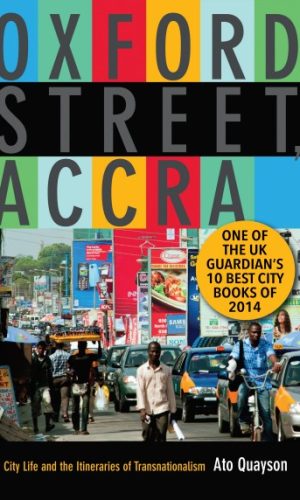
Oxford Street, Accra: City Life and the Itineraries of Transnationalism
In Oxford Street, Accra, Ato Quayson analyzes the dynamics of Ghana’s capital city through a focus on Oxford Street, part of Accra’s most vibrant and globalized commercial district. He traces the city’s evolution from its settlement in the mid-seventeenth century to the present day. He combines his impressions of the sights, sounds, interactions, and distribution of space with broader dynamics, including the histories of colonial and postcolonial town planning and the marks of transnationalism evident in Accra’s salsa scene, gym culture, and commercial billboards.
Quayson finds that the various planning systems that have shaped the city—and had their stratifying effects intensified by the IMF-mandated structural adjustment programs of the late 1980s—prepared the way for the early-1990s transformation of a largely residential neighborhood into a kinetic shopping district. With an intense commercialism overlying, or coexisting with, stark economic inequalities, Oxford Street is a microcosm of historical and urban processes that have made Accra the variegated and contradictory metropolis that it is today.
“Oxford Street, Accra offers a fresh portrait of a rising African metropolis by one of the most original and skilled critics of the African condition. Deeply researched and packed with detail and bold in scope and analysis, Oxford Street, Accra is a unique addition to the growing body of work on contemporary African Urbanism. This extraordinary book shows the extent to which the future of urban theory might well lie in the global South.” – Achille Mbembe, author of Critique de la raison négre.
KEY SELLING POINTS:
- Oxford Street, Accra is a must-buy as an invaluable companion and compass for both newcomers and returning visitors to Accra.
- Oxford Street, Accra was chosen as one of the ‘UK Guardian’s 10 Best City Books of the World in 2014.’
- Oxford Street, Accra was also the Co-Winner of ‘The Urban History Association’s Top Award in the International Category For Books Published About World Cities in 2013 – 2014.’
- Oxford Street, Accra contains an encyclopedic knowledge of the City of Accra, tracing the city’s evolution from its settlement in the mid-seventeenth century to the present day.
- The book offers a microcosm of historical and urban knowledge of the making of the city that have transformed Accra into the sophisticated metropolis that is it today.
₵160.00 -
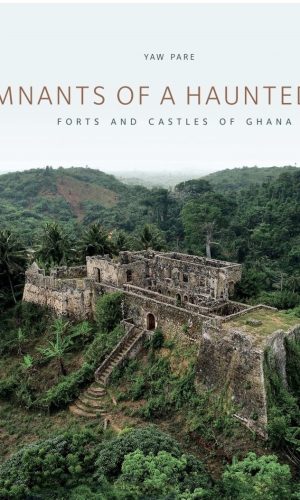
Remnants of a Haunted Past: Forts and Castles of Ghana (Photo Book, Hardcover)
Yaw Pare is a celebrated Ghanaian photographer. This ground-breaking book richly illustrates the history and legacies of Ghana’s forts and castles through photography. In the same way that the forts and castles themselves bear witness to the horrors of the transatlantic slave trade and slavery, so too do these photographs provide compelling material and visual testimonies, offering possibilities for understanding that words do not.
In this book, the photographer’s camera captures a reality that many choose to remember but just as many choose to forget. Ultimately, Remnants of a Haunted Past: Forts and Castles of Ghana constitutes an attempt to document the past so that it is never forgotten in the present.
Price range: ₵1,250.00 through ₵1,450.00Remnants of a Haunted Past: Forts and Castles of Ghana (Photo Book, Hardcover)
Price range: ₵1,250.00 through ₵1,450.00 -
The Evolution of Parliament in Ghana
This study provides an overview of the development of Ghana’s parliament from 1844 when it was under British colonial jurisdiction, through transition to sovereign rule in the 1950s. It further covers the period post the 2000 elections, the third successive multiparty elections, and consolidation of multi-party democratic governance. Some of the topics covered include: the various post-independence constitutions, the committee system, the introduction of women to parliament, and parliament and the media. An essay analysing the strengths and weaknesses of the parliamentary system and snapshot portraits of the presidents and speakers conclude the volume.
₵250.00 -
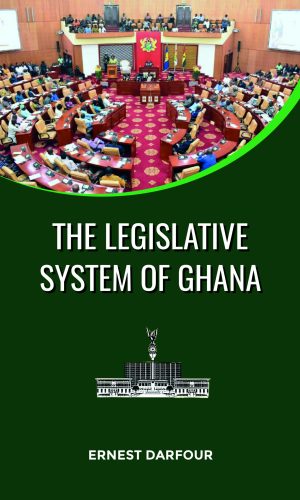
The Legislative System of Ghana
This book focuses on the legislative system of Ghana. It contains sixteen chapters, each focusing on a unique aspect of the legislative system of Ghana. It outlines the rules, the practice, and procedure that govern the conduct of business and Members in the Parliament of Ghana and its committees, and the various actors involved in the organisation of the legislative business. It breaks into minute forms, the procedural norms, and attitudes that influence members’ behaviour and the various parliamentary outcomes.
“This study is well researched and presented in a very lucid form…. Indeed, it is a very useful source for students, parliamentarians, and academics on the parliamentary history, procedure, and practice of Ghana’s Parliament.” – Hon Dr. Benjamin Kunbour, Former Majority Leader, Former Minister of Defence and Senior Lecturer, University of Ghana School of Law
₵300.00The Legislative System of Ghana
₵300.00 -
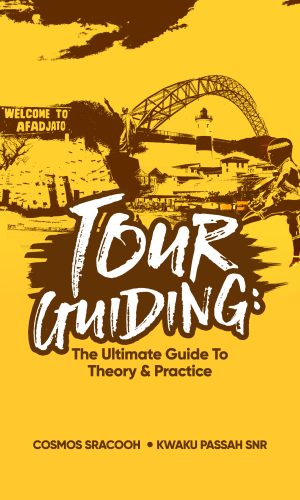
Tour Guiding: The Ultimate Guide to Theory and Practice
**Available from 16 October, 2021
Guides are tourism professionals who lead their guests through the most interesting parts of their region. It is their task to engage visitors and to help interpret the sights that they visit. They please tourists by telling interesting but relevant narratives and respond in proactive ways to their complaints and requests. Guides are trained to always have enough knowledge and insight about the subject of the tour and ensure the safety and satisfaction of their guests.
In this handy resource book, two seasoned practitioners have combined their working experience of a lifetime. What makes this book priceless is that it is enriched by over two decades of guide training experience as well as engagements with colleague guides, tourism professionals and a cross-section of tourists.
“The scope of coverage is vast and will be very useful as a general guidebook for any reader seeking access to our history, geography and our rich cultural heritage.” – Mrs. Stella W. Appenteng, CEO, Apstar Tours Limited
“Tour guiding is a bridging process around which the tourism experience revolves. This book comes to edify our tour guides on the substance and mechanics of their profession. It comes at a time when the industry has become more dynamic and in need of accurate, adequate, culture-nuanced interpretations.” – Tata Nkunu Akyea, Tourism Consultant & Tour Guide Extraordinaire
₵75.00 -
The Presbyterian Church of Ghana (P.C.G.): History and Impact
Jesus the Christ proclaimed the Great commission at the close of his earthly work in the first century. But it was not until around the last quarter of the 15th century that, according to a Papal arrangement, the Portuguese reached the Ghanaian coast with the Gospel, but with an economic motive which was expressed as follows:
To divert to the coast and hence directly to Portugal the wealth of the gold trade across the Sahara, with the hope that the material gain therefrom would enable Portugal better wage that crusade against Islam.
Later, other European nations followed with Empire-building motives. This involved the natives in fighting European religious wars. This spilled over into Africa as the European nations took colonies.
Development in other parts of the world gave a spark to the buying and selling of humans as slaves. Europe came to regret the trade’s evil effect and, therefore, decided to compensate the bleeding African continent through holistic ministry spearheaded by missionaries.
This book traces how Ghana was colonized and evangelised. It narrows down to the activities of the Basel Evangelical Missionary Society (BEMS). This eventually gave birth to the Presbyterian Church of Ghana (PCC).
A colonial Governor complimented the Mission on the eve of World War 1 as follows:
“The government regards the work of the Basel Mission as incomparably the best in the Gold Coast (GC). It is no exaggeration to say that the Mission makes the G.C.”
The book highlights how the P.C.G. has continued in holistic ministry towards the national wellbeing.
The author Kofi Nkansa-Kyeremanteng who passed on at the age of 70 (in the year 2007) had blue Presbyterian blood running in his veins. He schooled and later taught in Presbyterian Educational institutions. Through his writing and publishing activities, dating back to 1976, Mr. Nkansa Kyeremanteng’s name has won attachment to literature pertaining to the church.
₵60.00 -

Waning Strength of Government: Essays on Nigerian Governance
In Waning Strength of Government, Obaze draws on twenty-three of his various speeches, policy briefs, lectures and op-eds, to render exploratory essays that dissect some common patterns and trajectories that point anthetically to factors and conducts, which ought to constitute the strength of government, but don’t. In so doing, he unmasks the prevailing weaknesses and waning strength of government – the attendant consequences, and their prevalence and implications for Nigeria.
Such developments, with the attendant reversals, some nondescript and some dramatic, but replete with absence of resilience, leads the author to assert that democracy, “once characterized as probably the greatest expansion of freedom,” has come under assault from within its ranks, as shifts in geopolitics combine with ascendancy of non-state actors to undercut democracy. Cognizant of the suggestion that the democratic system as conceptualized, has not just worked as expected, but is rather dysfunctional, the author asserts that nowhere is this consideration more evident and concrete than in Africa, Nigeria included.
Waning Strength of Government piggybacks on the assertion that Nigeria’s “democracy is in reverse gear” and “the story is that of regrets and missteps.” Obaze employs an inquiry and excursion model using the flipside of McGeorge Bundy’s 1968 seminal book, The Strength of Government, to analyze leadership, political and governance challenges that continue to dog Nigeria’s nascent democracy. The essays in this volume, which are clustered into four groupings; democratic imperatives; domestic development challenges; foreign policy dimensions and leadership and governance, explore some Strength, Weaknesses, Opportunities and Threats (SWOT), as well as general challenges and uncertain aspects of Nigeria’s affected democracy.
In this very important work on Nigerian contemporary politics, leadership and dilemmas confronting the nation, the point is made severally, and vehemently too, that the strength of government is not about military capacity or use of force; but about the upholding the rule of law, consolidating democratic institutions and entrenching the social contract between the government and the governed.
₵75.00 -

Times, Thoughts and Ideas: Selected papers of Professor Anya O. Anya (Volume 1)
Selected papers of Professor Anya O. Anya.
Compiled and Edited by Ndubuisi Ofondu, Ireke A Kalu Onuma, Ogbonna Oleka.
₵75.00 -
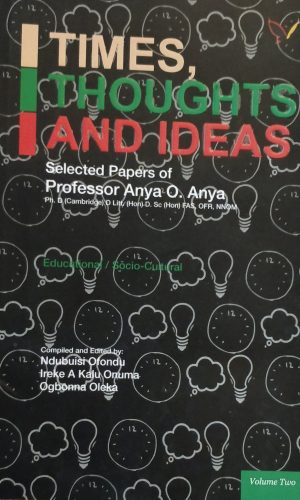
Times, Thoughts and Ideas: Selected papers of Professor Anya O. Anya (Volume 2)
Selected papers of Professor Anya O. Anya.
Compiled and Edited by Ndubuisi Ofondu, Ireke A Kalu Onuma, Ogbonna Oleka.
₵75.00 -
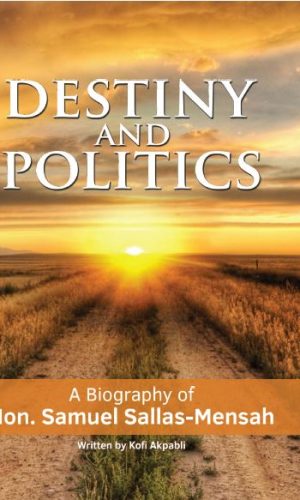
Destiny and Politics: A Biography of Hon. Samuel Sallas-Mensah
From a humble beginning as the son of a farmer in a relatively small town, Hon. Samuel Sallas-Mensah, four terms MP for Upper West Akim would perhaps have ended up as a farmer too. In those days, children took after their parents’ trades. Sallas got the chance to go to America and the entire course of his life changed. After a distinguished career in accountancy in the US and later in Nigeria, destiny led his way once more but this time to the country of his birth, Ghana, where eventually, a new career window opened in his life – politics.
As a Member of the Consultative Assembly his accounting and financial acumen were in evidence as he actively contributed to the District Assembly Common Fund. And as a Member of Parliament he was instrumental in instituting the live television coverage of the sitting of the Public Accounts Committee – legacies to the nation that survive today.
In this compelling biography the reader come face-to-face with this influential man of few words who is famed to have friends and access to both sides of the Ghanaian political divide. But what would Sallas be remembered for most, a politician, a chartered accountant or family man? More importantly, where else will destiny lead him to?
“Crispy-delicious narratives, refreshingly-garnished insights. This fascinating biography of a patriot never finishes astonishing you with the twists and turns. But it is the authoritative revelations about a nation and its people that makes this book destined to be relevant to the politics of Ghana.” ~ Business & Financial Times
₵45.00 -
A Guide to Autopsy Practice in Ghana (Hardcover)
This book is meant to guide the Ghanaian resident doctor, district and regional medical officers, medical students, non-medical personnel such as police detectives and traffic officers and lawyers through the rudiments of autopsy practice. It sheds light on the benefits of the autopsy, autopsy practice and the laws that govern autopsy practice and general academic dissections. It also discusses religion and the autopsy and is thus useful to religious leaders and curious general readers who may not belong to any of the above stated professions.
In addition it discusses the rudiments of death certification with relevant examples and will be useful to nosologists and other health officials responsible for collecting and coding data related to cause of death certificates. It entrenches the role of the clinical pathologists who is a part of the clinical team by introducing the perspectives and relationship of various clinicians to autopsy practice.
₵100.00 -
Medical Microbiology Simplified (2nd Edition)
The first edition of this title was published in 2012 with two main sections covering Bacteriology and Mycology. It provided students with a quick, updated, concise and an easy to understand text on medical microbiology. Each chapter discussed a set of closely related pathogens by focusing on their epidemiology, pathogenesis, laboratory diagnosis, treatment, prevention and control. These discussions were made against the backdrop of relevant historical contexts and current trends in molecular biology, bioinformatics and contemporary global health perspectives. The book was well received by both students and faculty and this has largely motivated a second edition.
The current edition is a revision of the first with additional content covering organisms not captured earlier. The present edition now includes sections on Parasitology and Virology to provide the full range of Microbiology disciplines. The sole author of the first edition (Dr. Mrs. Dorcas Obiri-Yeboah) invited other experts to contribute to the second edition. These experts were drawn from the Department of Microbiology and Immunology of the School of Medical Sciences, University of Cape Coast and included Prof. E. E. Brako and Dr. Victor Nuvor who contributed to the virology section; Mr. Daniel Amoako-Sakyi, Mrs. Faustina Pappoe and Mr. Kwabena Dankwa contributed the parasitology section.
This edition still aims to provide a concise, updated and easy to understand text for all range of students of Medical Microbiology. It is unique in its ability to teach complex concepts in an easy to grasp manner. Illustrations are included to aid comprehension of the subject where necessary. The text also takes time to succinctly describe and explain the virulence factors of viral, bacterial and fungal pathogens. It also explains the complex life cycles of parasites and how they have co-evolved to be checked up with their human host.
It is hoped that this second edition help readers to gain understanding of the subject and further develop their love for the great field of Medical Microbiology.
₵100.00