-
Proceedings of the Ghana Academy of Arts and Sciences (Volume III, 1965)
Proceedings, 1965. This issue contains the first series of the J.B. Danquah Memorial Lectures delivered by Justice W.B. van Lare in February 1968.
Contents
Address by Osagyefo Dr. Kwame Nkrumah at the Academy of Arts and Sciences Dinner on Saturday, 30th November 1963
Science in the Service of Agriculture – Sir William Slater
New Frontiers in Geography – Professor E.A. Boateng
Science and Social Progress – Professor A.N. May
The Importance of Environmental Sanitation in the Development of Low-Cost Housing Schemes – Mr. E. Lartey
Inermicapsifer Guineensis Graham (1968), A Review and Redescription – Dr. Leticia E. Obeng
Aspects of the Biosynthesis of Phenolic and Related Compounds – Professor F.G. Torto
₵20.00 -
Proceedings of the Ghana Academy of Arts and Sciences & The J.B. Danquah Memorial Lecture, Series 1 (Volume VI, 1968)
Proceedings, 1968. This issue contains the first series of the J.B. Danquah Memorial Lectures delivered by Justice W.B. van Lare in February 1968.
Contents
Presidential Address – Justice N.A. Ollenu
Medical Educatioin – Dr. John R. Ellis
Space Research and Its Relevance to Developing Countries – Rev. Professor John R. Koster
The Relationship between Overweening Pride and Retribution – Professor L.H. Ofosu-Appiah
Sudden, Unexpected and Unexplained Deaths in Accra, Ghana – Dr. William Neizer Laing
The Law, Human Rights and the Judiciary (The 1st J.B. Danquah Memorial Lectures) – Justice William Bedford van Lare (The J.B. Danquah Memorial Lecture, Series 1)
₵20.00 -
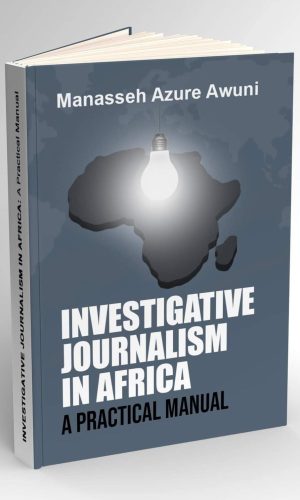
Investigative Journalism in Africa: A Practical Manual
“Few African investigative journalists I know are as invested in principled investigative journalism as Manasseh Azure Awuni. That trait has always come through in his exhaustive, impactful stories (some of which have featured in GIJN’s monthly and annual picks of top investigative stories from Africa). It is also abundantly evident in his new book, Investigative Journalism in Africa: A Practical Manual. In his own distinct, matter-of-fact style, Manasseh crafts a book that borrows from his own experiences to map a path for journalists who want to follow in his footsteps or learn from his unique experiences. By doing so, Manasseh has laid a crucial brick towards building African literature on investigative journalism on the continent. Most of the watchdog journalism study materials available in Africa come from the West. Manasseh’s effort is a commendable and timely step in the right direction, which I hope other investigative journalists across Africa can aspire to emulate.” − Benon Herbert Oluka, Africa Editor of Global Investigative Journalism Network (GIJN)
“Manasseh Azure Awuni makes investigative journalism so practical in this manual. He dissects the thorny and hidden issues that you would not get in your average classroom. This book crafts the very basis of my intellectual thinking of what investigative journalism should be about. It is a must- read for every student who wants to achieve greater heights in investigative journalism across the world.” − Anas Aremeyaw Anas, Award-winning Ghanaian investigative journalist
“This book is rich with practical and theoretical knowledge from one of the foremost investigative journalists in Africa. An invaluable resource for both professionals and students.” − Prof. Audrey Gadzekpo, former Dean of the School of Information and Communication Studies, University of Ghana
“Students with a dream to pursue public interest and accountability journalism will find exceptional value here, but practitioners will do themselves a world of great value if they also keep a copy on the reading table.” − Dapo Olorunyomi, Publisher of Premium Times, Nigeria
₵100.00 -
Falls in Ghana: Unified Guide Books & A Coffee Table Photobook (Chasing Waterfalls with Steve Ababio & Gina Arthur)
Waterfalls in Ghana are interesting, delightful and well worth the effort to seek out and explore. While Ghana does not have any with the sheer vast height or width of say Niagara Falls on the US-Canada border, or Victoria Falls in East Africa, falls in Ghana offer a much closer personal interaction in that you can stand under or much closer to the cascades and bathe or swim in their plunge pools.
The Chasing Waterfalls with Steve Ababio & Gina Arthur Guide books help make your personal journey a lot easier and more rewarding as you get to pick and choose the sort of experience you prefer. The Coffee Table Book is the perfect gift for anyone you’d like to introduce to Ghana, for your own enjoyment.
₵1,300.00₵1,350.00 -
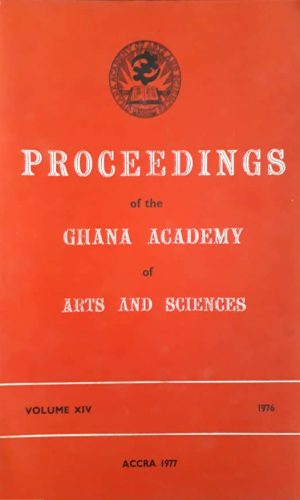
Proceedings of the Ghana Academy of Arts and Sciences (Volume XIV, 1976)
Proceedings, 1976.
Contents
Address by Dr. R.K.A. Gardiner, Commissioner for Economic Planning, on the occasion of the 16th Anniversary Dinner of the Ghana Academy of Arts and Sciences
Address by the President of the Academy, Professor E.A. Boateng on the occasion of the 16th Anniversary Dinner of the Ghana Academy of Arts and Sciences held on November 28, 1975
The Two Faces of Development – Professor E.A. Boateng
The Energy Problem in Perspective – Professor D.A. Bekoe
The Black Pod Disease of Cacao – Observations on the Parasite – Professor G.C. Clark
On the Growth of Man – Professor S. Ofosu-Amaah
Physical Sources of Energy – Dr. A.N. May
Chemical Sources of Energy – Dr. W. R. Philips
Biological Sources of Energy – Professor E. Laing
Nuclear Pollution – Dr. B.W. Garbrah
Biological Pollution – Professor S. Ofosu-Amaah
The Oil Crisis and its Impact on Ghana – Dr. Kobena G. Erbynn
The Economics of Energy in Ghana – Dr. Assibi O. Abudu
The Political Aspect of Energy for Development – Mr. W.S. Parker
₵20.00 -
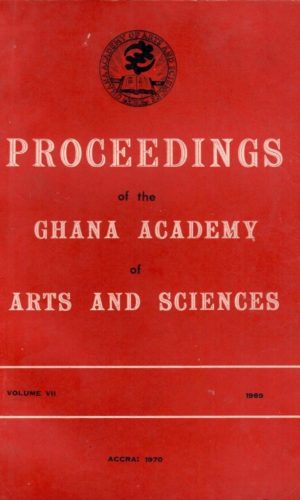
Proceedings of the Ghana Academy of Arts and Sciences & The J.B. Danquah Memorial Lecture, Series 2 (Volume VII, 1969)
Proceedings, 1969. This issue contains the second series of the J.B. Danquah Memorial Lectures delivered by C. A. Ackah in 1969.
Contents
Drugs and Our Society – Professor A.N. Tackie
Science and Religion – Professor J. Yanney Ewusie
Some Fundamentals in the Political Scene – C.A. Ackah (The J.B. Danquah Memorial Lecture, Series 2)
A Systems Approach to the Provision of Urban Facilities – E.D. Ehrenkrantz
Urban Planning – S.B. Amissah
Administration, Economics and Finance of Urban Planning – J.W.S. de Graft-Johnson
Housing – J. Owusu Addo
Communications – A.L. Bright-Davies
Urban Transportation – Mr. E. Lartey
Electric Power Supply – G.K. Homenoo
Problems of Urban Water Supply – C.K. Annan
Problems of Environmental Sanitation – H. Noye-Nortey
₵20.00 -
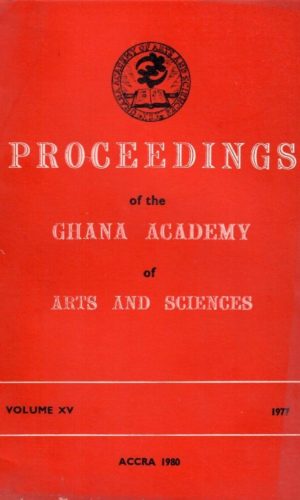
Proceedings of the Ghana Academy of Arts and Sciences (Volume XV, 1977)
Proceedings, 1977.
Contents
Address by Major-General F.W.K. Akuffo, Chief of Defence Staff on the occasion of the 17th Anniversary Dinner of the Academy of Arts and Sciences held on November 27, 1976
Address by the President of the Academy, E.A. Boateng on the occasion of the 17th Anniversary Dinner of the Academy of Arts and Sciences held on November 27, 1976
Human Settlements and the Environment – Professor E.A. Boateng
A Strategy to Accelerate the Development of the Rural Areas of Ghana – Professor J. Yanney-Ewusie
Philosophy and our Culture – Kwasi Wiredu
Cocoa Production in Ghana: some present problems and future strategies – E.J.A. Asomaning
The Impact of Demographic Changes on Ghanaian cities, towns and villages – S.K. Gaisie
Human Settlement Planning in Ghana – P. Austin Tetteh
The Urban Worker in the Context of the Journey to and from Work – F.A. Ablorh
Health and Slums – Mr. L.K.A. Derban
Traffic Within Our Cities – Mr. E. Lartey
Social Problems – David Acquah
Economic Activities in the Rural and Urban Cities of Ghana – K.B. Dickson
₵20.00 -
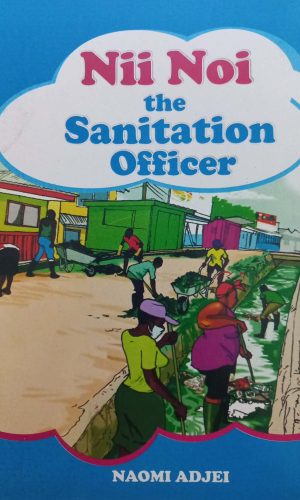
Nii Noi the Sanitation Officer
Age Range: 6 – 15 years
This book is a thought-provoking piece of a fairly peaceful community that wakes up to the incessant complaints of 13-year-old Nii Noi. Like the dawn of teenage, he becomes, somewhat, shocked by the deplorable sanitary conditions in his neighbourhood.
Fuming at the apathy of everyone around him towards better sanitation practice, Nii Noi becomes a crusader for hygienic living. But as a prophet without honour in his community, it takes the tragedy of a flood to get the community to appreciate the crusade by Nii, and what he desires to achieve: a hygienic, clean and joyful community. The writer, through the voice and eyes of a boy, reveals the innocent naivety and obvious apathy of society, and the power of camaraderie and community to cause change.
₵18.00 -
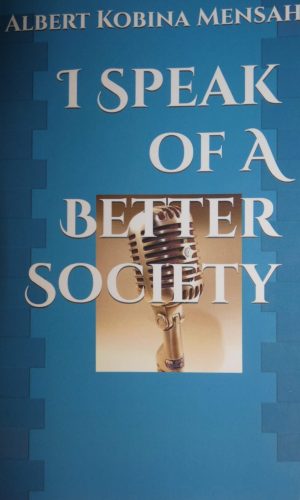
I Speak of A Better Society
In this book, I Speak of a Better Society, I argued for a better society in Africa. A better society is coined as one where individuals therein could achieve their full potential. The African with the dream to be like anyone in Europe or North America. The African with a higher loyalty to truth, integrity, values, and good leadership. The African who needs a level-playing field to compete with the rest of the world. And, the African who has passion to change their world because the status-quo is wrong. In a better society, there is a fair play. In creating such society, additional values such as pragmatism, meritocracy, honesty, equity, and putting humanity topmost priority, count and matter.
The book advances my personal experiences, ideas, arguments, and opinions for creating a better society fair and just for all citizens in Africa. I argued that Africa is not poor and that we could create a better society for the indigenes therein, if we could have the right leadership in place and when we the citizens could change our attitudes as people.
₵75.00I Speak of A Better Society
₵75.00 -
Social Structure of Ghana: A Study in Persistence and Change
When Social Structure of Ghana was first published in 1981, it became the only comprehensive and sociological attempts to examine the institutional framework of the entire Ghanaian society. It still is. In this 1999 edition, the author updates most of the data on Ghana, and analyses in greater detail some of the issues raised therein. These issues include the military in politics, religious sectarianism, social problems, educational reforms and the world of work, and the shifting loyalties of Ghanaians to kin groups, tribes and the nation.
As the twentieth century comes to a close, this book probably represents the last major publication on Ghana that analyses the country’s human and material resources for confronting the challenges of the next century.
The book will continue to be useful for studies in sociology, ethnography, political science, African studies, medical sociology value systems, nursing and social work.
₵203.00 -
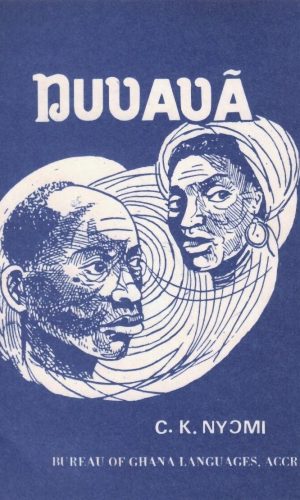
Ŋuʋaʋa (Ewe)
Good and evil aspects of jealousy are discussed in this Pamphlet.
₵13.00Ŋuʋaʋa (Ewe)
₵13.00 -
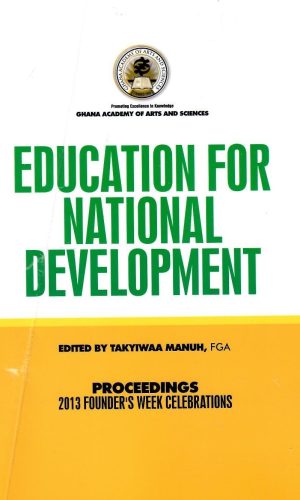
Proceedings of the Ghana Academy of Arts and Sciences (2013 – Education for National Development)
Proceedings, Founder’s Week Celebrations, 2013
Contents
Foreword — Professor Takyiwaa Manuh
Presidential Address: Education in the Age of Rapid Technological Advancement — Professor Francis K.A. Allotey
Basic Education in a Changing World: Rethinking the Role of Stakeholders in Ghana — Dr. Christiana Amoako-Nuama
The Quality and Inclusivity of Basic Education across Ghana’s three Northern Regions: Assessing Learning Effectiveness and Efficiency towards the Post 2015 Era — Dr. Leslie Casely-Hayford
Reviewing Secondary, Technical Education and Skills Training in Ghana — Dr. George Afeti
Skills Diversification to meet Current and Future Labour Market Opportunities in Ghana — Professor G.K.S. Aflakpui
Higher Education beyond the Labour Market — Professor Helen Lauer
Kwame Nkrumah Memorial Lecture: Knowledge and Innovation for Agricultural Development — Professor Kwadwo Asenso-Okyere
₵30.00