-
The Daughters of Nandi
As she took her dying breath, Nandi Mhlongo, mother of Shaka kaSenzangakhona, cursed the house of Zulu and her family, the Mhlongos, for the disrespect she endured at their hands. In the ancestral realm, Nandi worries that her malediction may have been rash and too dangerous for the descendants of the two houses. The curse can be undone but it will need a human medium to convey the message to the progeny.
Through three historical periods, three women who are extraordinary in their different ways will seek to get restitution for Nani. Gentle Keeya, a Motswana woman of the House of Moagi who marries one of Nandi’s descendants as the English, the Boers and the Zulu go to the war in the 19th century; Uju, a spirited married woman who carves a space for herself in history during the forced removals of Sophiatown in the 20th century; and in the 21st century Amangwe, who reluctantly joins her fellow students as they speak up against a meaningless freedom during the #FeesMustFall protests.
Will any of these three women manage to ensure Nandi Mhlongo is appeased and if not, what shall be the consequences to the Houses of Mhlongo and Zulu and to the three Daughters of Nandi themselves?
An engaging debut which seamlessly weaves fact, fiction and spiritualities while subverting the way the reader perceives history.
₵100.00The Daughters of Nandi
₵100.00 -
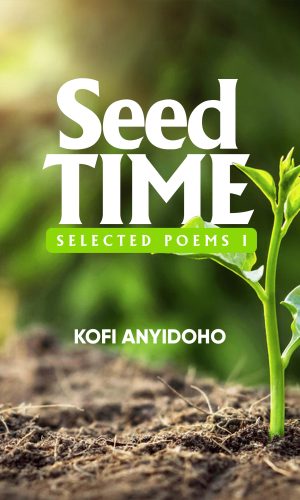
SeedTime: Selected Poems I
In memory of all the Ancestral Voices who prepared the field for our SeedTime…
SeedTime I brings together Selected Poems from Kofi Anyidoho’s first five collections, beginning in reverse order with poems from AncestralLogic & CaribbeanBlues (1993), A Harvest of Our Dreams (1984), EarthChild (1985), Elegy for the Revolution (1978), and BrainSurgery (1985). BrainSurgery, the earliest of these collections, was never published as a collection until it came out together with EarthChild (Woeli Publishing Services, 1985), even though several of the poems had appeared in various journals, magazines and anthologies.
SeedTime: Selected Poems I is a backward glance to those magical years of birth waters flowing across a landscape filled at once with danger and hope, with dying and rebirth in the mystery and miracle of new beginnings so soon after countless brushfires. But the doubt returns again so close behind the hope as we offer trembling prayers in new poems from an old loom: See What They’ve Done To Our SunRise. Yet, somehow, we must open our minds and souls to the Forever Promise of New SeedTimes. This world cannot, must not crumble under our watch.
“Quintessential Anyidoho…a harvest of the master craftman’s gems across time and space. SeedTime brings a refreshing newness to old songs, and, for new ones, a touch of creative genius we have come to associate with the poet’s pedigree; a timeless legacy of a poet-laureate, whose voice waxes even stronger in his twilight years.” − Mawuli Adjei, author, poet and literary scholar
“A collection of haunting poems in which we SEE the turbulent variety of our history, and HEAR the English language teased to express the many rhythms of the African’s eternal homesickness.” − Prof. A. N. Mensah, Department of English, University of Ghana
₵100.00SeedTime: Selected Poems I
₵100.00 -
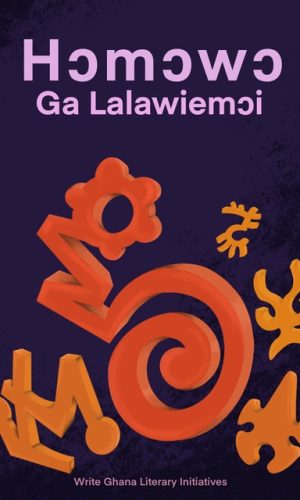
Hɔmɔwɔ: Ga Lalawiemɔi
Hɔmɔwɔ: Ga Lalawiemɔi is a collection of Ga poetry by thirteen (13) contemporary poets.
Featuring nineteen (19) poems, the poems cover different themes such as pandemics, Ga heritage, family, memory, childhood and love.
Written completely in Ga, the book is a groundbreaking addition to the Ga language literary scene.
₵94.00Hɔmɔwɔ: Ga Lalawiemɔi
₵94.00 -
Flood Season
After over a decade working as a musician under the name Kae Sun, Kwaku Darko-Mensah Jnr. makes a full-blooded return to poetry. His début Flood Season explores diasporic lives, the tensions between who we are and the clichés that surround our nation states, and hybridity. These are poems that carry their weight easily, fizz with the joy of a burst man.
₵80.00Flood Season
₵80.00 -
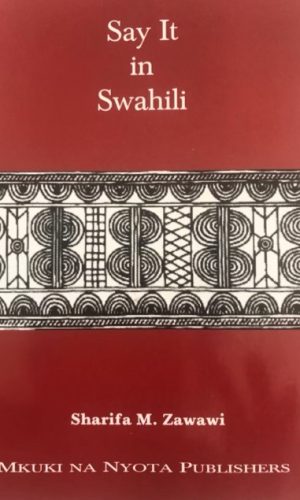
Say It in Swahili
Contains over 1,000 useful sentences and phrases for travel or everyday living abroad: food, shopping, medical aid, courtesy, hotels, travel, and other situations. Gives the English phrase, the foreign equivalent, and a transliteration that can be read right off. Also includes many supplementary lists, signs, and aids. All words are indexed.₵50.00Say It in Swahili
₵50.00 -
Swahili-English Pocket Dictionary
A concise and portable dictionary developed by two experienced and well respected teachers of Swahili. In this work they have taken into account not only the difficulties which non-Swahili speakers from many different language backgrounds have in learning the language, but also the importance of making Swahili equivalents of English words, correspond to those of the best speakers of Swahili.The English-Swahili Pocket Dictionary will be of benefit to English speakers who are learning Swahili, while Swahili speakers who are learning English will also find it invaluable.₵50.00 -
English-Swahili Pocket Dictionary
A concise and portable dictionary developed by two experienced and well respected teachers of Swahili. In this work they have taken into account not only the difficulties which non-Swahili speakers from many different language backgrounds have in learning the language, but also the importance of making Swahili equivalents of English words, correspond to those of the best speakers of Swahili.The English-Swahili Pocket Dictionary will be of benefit to English speakers who are learning Swahili, while Swahili speakers who are learning English will also find it invaluable.₵50.00 -
Swahili Made Easy: A Beginner’s Complete Course
This handy book is a beginner’s complete course in the Swahili language, designed especially for foreigners. The book is a result of the author’s many years of teaching experience. It is divided into two parts: part one covers pronunciation; Swahili greetings and manners; classification of nouns; adjectives, verbs, adverbs, etc. in twenty-eight lessons and thirty-six exercises. part two includes a study of Swahili usage in specific situations (e.g. at home, in the market, on the road, at the airport, etc.); eleven further lessons and thirteen exercises; the key to the exercises in Parts One and Two; and a Swahili-English vocabulary of words used in the book.
₵50.00 -
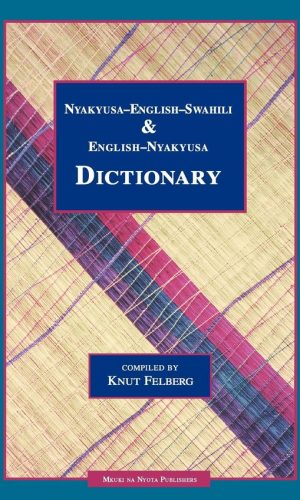
Nyakyusa-English-Swahili & English-Nyakyusa Dictionary
Unhappy with the policy of using English as the medium of instruction in secondary schools in Tanzania which left his students bewildered, a Norwegian volunteer teacher in Ipinda, Tukuyu, south western region of Tanzania decided that his students would probably cope with the foreign language only after they were grounded first in the structure of their own languages — Nyakyusa and Swahili. As a trilingual dictionary was not available, he set out to compile one and this well-produced dictionary is the product. Words, examples and usages are included.
₵75.00 -
From Dar es Salaam to Bongoland: Urban Mutations in Tanzania
The name Dar es Salaam comes from the Arabic phrase meaning house of peace. A popular but erroneous translation is ‘haven of peace’ resulting from a mix-up of the Arabic words “dar” (house) and “bandar” (harbour). Named in 1867 by the Sultan of Zanzibar, the town has for a long time benefitted from a reputation of being a place of tranquility. The tropical drowsiness is a comfort to the socialist poverty and under-equipment that causes an unending anxiety to reign over the town. Today, for the Tanzanian, the town has become Bongoland, that is, a place where survival is a matter of cunning and intelligence (bongo means ‘brain’ in Kiswahili). Far from being an anecdote, this slide into toponomy records the mutations that affect the links that Tanzanians maintain with their principal city and the manner in which it represents them.
This book takes into account the changes by departing from the hypothesis that they reveal a process of territorialisation. What are the processes – envisaged as spatial investments – which, by producing exclusivity, demarcations and exclusions, fragment the urban space and its social fabric? Do the practices and discussions of the urban dwellers construct limited spaces, appropriated, identified and managed by communities (in other words, territories)? Dar es Salaam is often described as a diversified, relatively homogenous and integrating place. However, is it not more appropriate to describe it as fragmented?
As territorialisation can only occur through frequenting, management and localised investment, it is therefore through certain places – first shelter and residential area, then the school, daladala station, the fire hydrant and the quays – that the town is observed. This led to broach the question in the geographical sense of urban policy carried out since German colonisation to date. At the same time, the analysis of these developments allows for an evaluation of the role of the urban crisis and the responses it brings.
In sum, the aim of this approach is to measure the impact of the uniqueness of the place on the current changes. On one hand, this is linked to its long-term insertion in the Swahili civilisation, and on the other, to its colonisation by Germany and later Britain and finally, to the singularity of the post-colonial path. This latter is marked by an alternation of Ujamaa with Structural Adjustment Plans applied since 1987. How does this remarkable political culture take part in the emerging city today?
This book is a translation of De Dar es Salaam à Bongoland: Mutations urbaines en Tanzanie, published by Karthala, Paris in 2006.
₵130.00 -
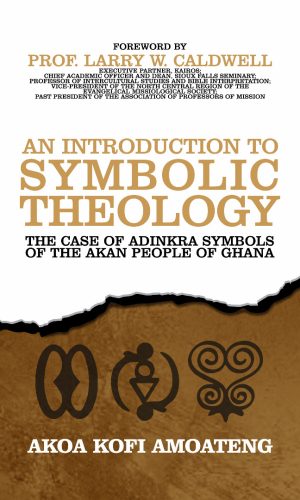
An Introduction to Symbolic Theology: The Case of Adinkra Symbols of the Akan People of Ghana
Akoa Kofi Amoateng strongly believes that Jesus’ incarnation into Jewish-specific culture and humanity as God’s communication to the world (Hebrews 1:1-3), implies the theological and understanding that God wants culture-specific peoples around the world to identify and relate to Him from their cultural and historic experiences and backgrounds. He, therefore, submits that theology and hermeneutics must be both contextual and rooted in ethnic epistemological realities. Akoa, therefore, calls for ethnothelogy and ethnohermeneutics, believing that, generally, there is nothing like one theological jackets that fits all peoples.
This work is a masterpiece and a paradigm shift into offering how peoples’ theologies and indigenous hermeneutical enterprises can be constructed in contextualization for the different peoples of the world.
“Amoateng draws attention to the critical role symbols play for African theology. He bemoans the neglect of the early missionaries to the symbolic realm which has left a paucity of theological reflections on the Adinkra symbols. He uses this lacuna to highlight symbolic theology within the wider purview of ethnotheology, which some scholars are calling ethnohermeneutics. The Adinkra symbols can thus be analyzed within the broader lenses of Africa’s rich oral history, especially if we understand orality much larger than verbal utterances, but to include symbols that speak even when words are absent.” — Gregg Okesson, Ira Galloway and D.M. Beeson Chair of Leadership Development and Evangelism; Dean, E. Stanley Jones School ofWorld Mission and Evangelism; Presidential Envoy and Director of Global Partnerships, Asbury Theological Seminary
₵100.00 -
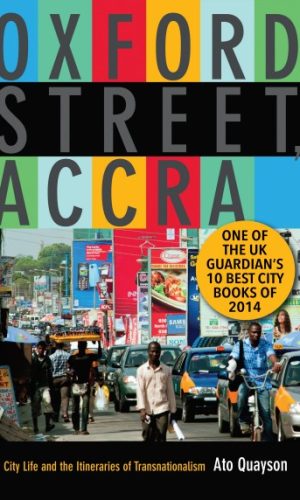
Oxford Street, Accra: City Life and the Itineraries of Transnationalism
In Oxford Street, Accra, Ato Quayson analyzes the dynamics of Ghana’s capital city through a focus on Oxford Street, part of Accra’s most vibrant and globalized commercial district. He traces the city’s evolution from its settlement in the mid-seventeenth century to the present day. He combines his impressions of the sights, sounds, interactions, and distribution of space with broader dynamics, including the histories of colonial and postcolonial town planning and the marks of transnationalism evident in Accra’s salsa scene, gym culture, and commercial billboards.
Quayson finds that the various planning systems that have shaped the city—and had their stratifying effects intensified by the IMF-mandated structural adjustment programs of the late 1980s—prepared the way for the early-1990s transformation of a largely residential neighborhood into a kinetic shopping district. With an intense commercialism overlying, or coexisting with, stark economic inequalities, Oxford Street is a microcosm of historical and urban processes that have made Accra the variegated and contradictory metropolis that it is today.
“Oxford Street, Accra offers a fresh portrait of a rising African metropolis by one of the most original and skilled critics of the African condition. Deeply researched and packed with detail and bold in scope and analysis, Oxford Street, Accra is a unique addition to the growing body of work on contemporary African Urbanism. This extraordinary book shows the extent to which the future of urban theory might well lie in the global South.” – Achille Mbembe, author of Critique de la raison négre.
KEY SELLING POINTS:
- Oxford Street, Accra is a must-buy as an invaluable companion and compass for both newcomers and returning visitors to Accra.
- Oxford Street, Accra was chosen as one of the ‘UK Guardian’s 10 Best City Books of the World in 2014.’
- Oxford Street, Accra was also the Co-Winner of ‘The Urban History Association’s Top Award in the International Category For Books Published About World Cities in 2013 – 2014.’
- Oxford Street, Accra contains an encyclopedic knowledge of the City of Accra, tracing the city’s evolution from its settlement in the mid-seventeenth century to the present day.
- The book offers a microcosm of historical and urban knowledge of the making of the city that have transformed Accra into the sophisticated metropolis that is it today.
₵160.00