-
Celebrated: Nigerian Women in Development
Celebrated profiles 29 contemporary Nigerian women who, through their own initiatives, are playing laudable roles in our society. They include lawyer and civil liberties activist Ayo Obe, fashion designer Deola Sagoe, and businesswoman Nike Ogunlesi. These women speak in Celebrated about their experiences, challenges and successes.
The problems relating to the social worth of a woman, her ability to contribute to social development, the political, economic and social roles she is allowed to play, her pains and travails are issues that haunt all societies. These problems usually arise from the way society sees the woman and the way the woman sees herself. Perhaps because of these problems, despite the past achievements of Nigerian women, the number of prominent contemporary Nigerian women remains negligible compared to that of men.
Ayona Aguele-Trimnell profiles here a few contemporary Nigerian women who, through their own initiatives, are playing laudable roles in society and yet remain largely uncelebrated. Women like Doctors Okonjo-Iweala, Obiageli Ezekwesili and Professor Dora Akunyili to name a few, who have performed as well as any, and better than most of their male contemporaries and predecessors. This is the sense in which this book become important.
₵50.00 -
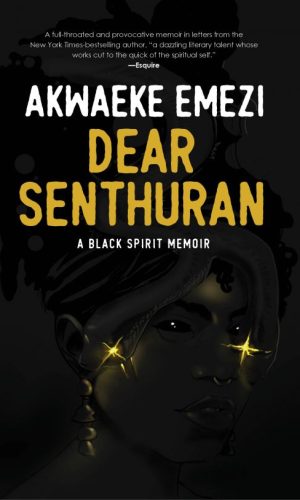
Dear Senthuran: A Black Spirit Memoir
In three critically acclaimed novels, Akwaeke Emezi has introduced readers to a landscape marked by familial tensions, Igbo belief systems, and a boundless search for what it means to be free. Now, in this extraordinary memoir, the bestselling author of The Death of Vivek Oji reveals the harrowing yet resolute truths of their own life. Through candid, intimate correspondence with friends, lovers, and family, Emezi traces the unfolding of a self and the unforgettable journey of a creative spirit stepping into power in the human world. Their story weaves through transformative decisions about their gender and body, their precipitous path to success as a writer, and the turmoil of relationships on an emotional, romantic, and spiritual plane, culminating in a book that is as tender as it is brutal.
Electrifying and inspiring, animated by the same voracious intelligence that distinguishes their fiction, Dear Senthuran is a revelatory account of storytelling, self, and survival.
₵120.00 -
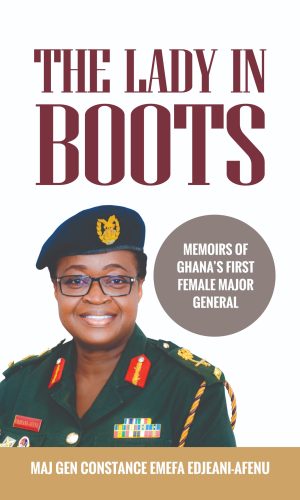
The Lady in Boots: Memoirs of Ghana’s First Female Major General
Available from 11th September, 2023
The book is Major General Constance Edjeani-Afenu’s remarkable memoir. It chronicles her 43-year extraordinary journey in the Ghana Armed Forces.
She was the first female Commanding Officer, and the first female Major General. Her story is a testimony to dedication, leadership, and resilience.₵100.00 -
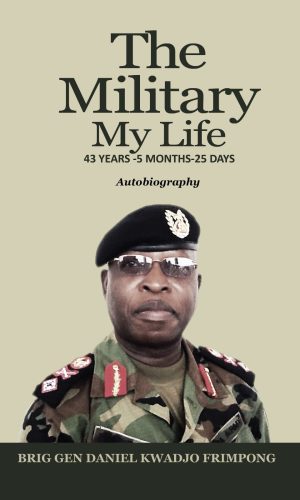
The Military, My Life: 43 Years – 5 Months – 25 Days: Autobiography
The Military, My Life: 43 Years – 5 Months – 25 Days: Autobiography is General Frimpong’s fifth book.
Starting from his primary school days across Ghana, his secondary education and enlistment into the Ghana Armed Forces in 1970, he discusses his long career in the military, community service, diplomatic life, incursions into academia, retirement in 2014 after over forty-three years’ service, and life after retirement.
He also discusses his sojourns in Nigeria, Kenya, Uganda, Canada and the USA.
Maj Don-Chebe states in the Foreword:
“For the officers who have schooled peacefully and smoothly in the Ghana Armed Forces, spare a thought for officers like Brig Gen Dan Frimpong, who blazed the trail and suffered all kinds of indignities to his person and unholy twists in his career path. His numerous runs-in with the Military High Command is a subject that should inform commanders at various levels that, a knowledge-based and future-focused Armed Forces needs a certain kind of officer hungry for knowledge and determined to compete with the best inside and outside.
“The autobiography of Brig Gen Dan Frimpong should give hope and confidence to young persons, inside and outside the Military to continue to pursue their dreams and aspirations. Any setback can only be temporary; persistence, perseverance, determination and grit should drive you forward.”
₵200.00 -
Men Across Time: Contesting Masculinities in Ghanaian Fiction and Film
Men Across Time: Contesting Masculinities in Ghanaian Fiction and Film examines the various constructions and manifestations of masculinities from precolonial, colonial, independent and post-independent Ghana as portrayed in selected Ghanaian fiction, film and music videos. Two main questions are engaged here:
- What predominant masculine images are present in Ghanaian texts?
- In what ways has the passage of time affected the subversion of dominant masculine images, contested hegemony and created room for the presence of alternative masculinities?
This book submits that in questioning the various masculine modes of behaviours portrayed in these texts, and negotiating their own masculine identities, the male characters showcase the mutations that are taking place within masculine representations over time and aver that other models of masculine expression are possible.
“This study’s engagement with the theory of hegemonic masculinity represents an important contribution to the discourse in gender studies in Ghana and Africa. In addition, it is well researched and presents a cutting-edge analysis of masculinity across genres. I cannot think of any other study in Ghanaian literary and cultural studies that provides such a broad historical background context and the book is certainly original in its approach.” — Professor Mansah Prah, Department of Sociology and Anthropology, University of Cape Coast, Ghana
“The book’s major strength is in adding significantly to an area of study that is currently under theorised. This has the potential to make a robust and important contribution to the field of knowledge on representation of masculinities in African and specifically Ghanaian popular culture.” — Associate Professor Nicky Falkof, Media Studies, University of the Witwatersrand, South Africa
₵300.00 -
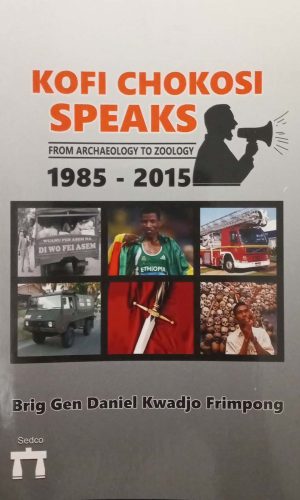
Kofi Chokosi Speaks: From Archaeology to Zoology (1985-2015)
This book provides all connoisseurs of Social Literature with a delightful array of bite-sized vignettes of man as a social animal. Kofi Chokosi’s extensive travels as a soldier have provided us with various perspectives of the enthralling human condition, whether in the military Cantonment of Burma Camp, Ghana, the hot steamy jungles of Cambodia or the lush green meadows of Southern England…next time you buy the Daily Graphic, look out for the musing of Kofi Chokosi – soldier, scholar, teacher and writer.
₵60.00 -
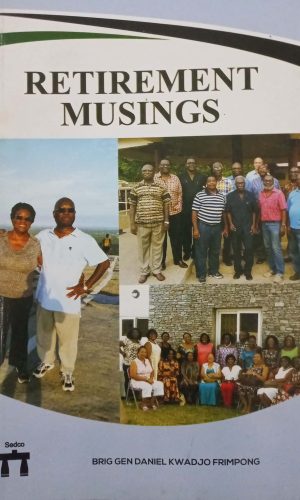
Retirement Musings
This collection of articles in the author’s personality captured in writing. They show his versatility and depth. General Frimpong’s writing is a model for writing crisp, straight-to-the-opinion pieces for mass circulation newspapers. But that doesn’t mean the pieces are dry. On the contrary, they shine with his sense of humour while retaining the discipline of word economy and sweet crunchy sentences.
It is especially telling that the General studied and taught at the Department of Philosophy at the University of Ghana, Legon. No subject is off limit and all thoughts are allowed! So, he discusses football, discipline, Kofi Annan, history and airplanes in this breathless book which reads like a single narrative, even though it is a collection of stories.
₵60.00Retirement Musings
₵60.00 -
Mindset Revolution III: To Build the Africa We Want; Our Move
*Lead time for delivery – 4 weeks
This is the handbook to the most important key to unlocking Africa’s power? Mindset.
Akosua Bame continues her popular Mindset Revolution series with this latest book, noting that everything that has ever been created began as a thought and thoughts are driven by mindsets. Without the right mindsets, Africa will remain caught up in this ever-vicious cycle of poverty and dependence on aid. In this book, the author seeks to empower her audience to play their part in resetting and rebuilding Africa, by sharing strategies for developing and embedding the seven mindsets that are necessary to realising the continent’s potential.
Here she discusses a visionary mindset, an evolutionary mindset, a legacy mindset, a knowledge-seeking mindset, a wealth-creation mindset, an entrepreneurial mindset and a health mindset. Akosua declares that Africa has been a cocoon for far too long; it is time for the butterfly to emerge. For that to happen, the people of Africa must turn inward, change the way they think, and then take steps to transform the continent. It is time for a paradigm shift. It is time for Africa to stop apologetically seeking a voice on the global stage. It is time for Africa to stop seeking solutions to its socio-economic problems by looking externally.
It is time for Africa to realise that the power and indeed the only way to transform comes from within. To build the Africa we want, to transform the continent, all it takes is this?
MINDSET REVOLUTION.
₵377.00 -
Mindset Revolution: Master Your Thoughts and Master Your Life
Everything that has ever been created or achieved began as a thought. Living a life of destiny requires one to gain mastery over their thoughts through a process of harmonising their spirit, soul and body. This means change, which although a constant in life, can be challenging; changing a mind-set even more so.
This book is aimed at giving readers, especially Africans, a different perspective of their circumstances. It challenges the subconscious beliefs they may have which may be holding them back from living their potential. Although set within an African context, the truths presented is the minimum daily dose of inspiration and life coaching anyone needs to kick start the revolution of their minds.
Through a pragmatic, humour filled, conversational style, Akosua exposes truths, laws and secrets for living a ‘truly’ winning life. In here she shares:
Why the natural state is a life of abundance
Why having a vision and dreaming is important
How the ‘secret’ to living your potential lies in your thoughts
How to discover and become more of the REAL you
Akosua says ‘come with an open mind, embrace the truths presented and you will begin to discover how gaining mastery over your thoughts can propel you into living your wildest dreams’.₵300.00 -
Africa: Poverty in the Midst of Plenty
This book posits that human beings are the most deceitful, dissimulator and complex creatures on earth. It is a critique of human behaviour, especially the African, and how he/she may be held responsible for his/her own under-development.
The book also contains some analysis on the West African socio -politico-economic realities to enable us to appraise the sources of imbalance in development between the North and the South and the fact that Africans cannot continue to blame colonialism and neo-colonialism for the uneven development. The solution is at our own doorstep.
The narratives are done independently but, put together, it is a labyrinth of the nature of the African and Africa. A must read for policy-makers, diplomats and students of Africa political economy.
₵40.00 -
A Charge to Keep
A Charge to Keep – a collection of his articles published since 1996 – is Raymond Tuvi’s third book. Bukom, the first article, was featured in the “My Town” segment of the July–September 1996 edition of the BBC Focus on Africa magazine.
Faith, Individual Character and National Development, is the composite theme that runs through the over 50 highly-readable essays. The Foreword is by Ambassador K.B. Asante, former Ghana High Commissioner to the United Kingdom, who served as Minister of Education, and Trade and Industry.
Osagyefo Dr. Kwame Nkrumah, Ghana’s first President and preeminent champion of the total liberation of Africa’s longtime Executive Secretary, Mr. K.B. Asante, as he’s popularly known to a Ghanaian populace that dotes on him as Elder Statesman, and probably the “Last of the Great Ghanaian Freedom Fighters”, writes:
“The book is a welcome addition to the growing number of books written by Ghanaians who should thereby be encouraged to read more widely. The truth is that we do not read much and this is shown by the narrowness of mind many of us exhibit on national issues. By this book, Raymond Tuvi is telling us that we have one less excuse for not having any idea about what we should know.”
₵120.00A Charge to Keep
₵120.00 -
From Dar es Salaam to Bongoland: Urban Mutations in Tanzania
The name Dar es Salaam comes from the Arabic phrase meaning house of peace. A popular but erroneous translation is ‘haven of peace’ resulting from a mix-up of the Arabic words “dar” (house) and “bandar” (harbour). Named in 1867 by the Sultan of Zanzibar, the town has for a long time benefitted from a reputation of being a place of tranquility. The tropical drowsiness is a comfort to the socialist poverty and under-equipment that causes an unending anxiety to reign over the town. Today, for the Tanzanian, the town has become Bongoland, that is, a place where survival is a matter of cunning and intelligence (bongo means ‘brain’ in Kiswahili). Far from being an anecdote, this slide into toponomy records the mutations that affect the links that Tanzanians maintain with their principal city and the manner in which it represents them.
This book takes into account the changes by departing from the hypothesis that they reveal a process of territorialisation. What are the processes – envisaged as spatial investments – which, by producing exclusivity, demarcations and exclusions, fragment the urban space and its social fabric? Do the practices and discussions of the urban dwellers construct limited spaces, appropriated, identified and managed by communities (in other words, territories)? Dar es Salaam is often described as a diversified, relatively homogenous and integrating place. However, is it not more appropriate to describe it as fragmented?
As territorialisation can only occur through frequenting, management and localised investment, it is therefore through certain places – first shelter and residential area, then the school, daladala station, the fire hydrant and the quays – that the town is observed. This led to broach the question in the geographical sense of urban policy carried out since German colonisation to date. At the same time, the analysis of these developments allows for an evaluation of the role of the urban crisis and the responses it brings.
In sum, the aim of this approach is to measure the impact of the uniqueness of the place on the current changes. On one hand, this is linked to its long-term insertion in the Swahili civilisation, and on the other, to its colonisation by Germany and later Britain and finally, to the singularity of the post-colonial path. This latter is marked by an alternation of Ujamaa with Structural Adjustment Plans applied since 1987. How does this remarkable political culture take part in the emerging city today?
This book is a translation of De Dar es Salaam à Bongoland: Mutations urbaines en Tanzanie, published by Karthala, Paris in 2006.
₵130.00