-
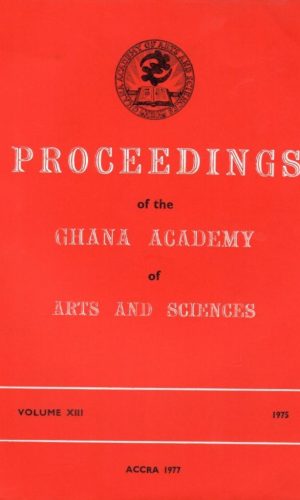
Proceedings of the Ghana Academy of Arts and Sciences (Volume XIII, 1975)
Proceedings, 1975.
Contents
Address by the Academy President at the 15th Anniversary Dinner – Professor E.A. Boateng
Tradition and Progress – Professor E.A. Boateng
Ghanaian Society in Change and Stability – Professor K.A. Dickson
The Study of French Literature: 17th Century French Drama and Corneille – Professor R.F. Amonoo
Chieftaincy in Ghana Yesterday, Today and Tomorrow – Nene Azu Mate-Kole
Chieftaincy in Ghana Yesterday, Today and Tomorrow – Nana Agyeman Badu I
Chieftaincy in Ghana Yesterday, Today and Tomorrow – Togbe Adza Tekpor VI
Chieftaincy in Northern Ghana – Mr. J.A. Braimah
Chieftaincy in Ghana Yesterday, Today and Tomorrow – Nii Anyetei Kwakwranya II
Traditional Marriage – Mrs. Emily Hesse
The Extended Family and Problems of Child Care in Modern Ghanaian Society – Dr. D.K. Fiawoo
The Family, the Individual and Inheritance – Professor W.C. Ekow Daniels
₵20.00 -
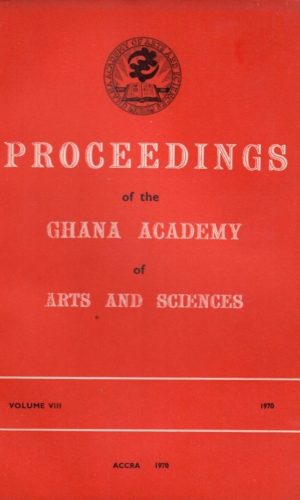
Proceedings of the Ghana Academy of Arts and Sciences & The J.B. Danquah Memorial Lecture, Series 3 (Volume VIII, 1970)
Proceedings, 1970. This issue contains the third series of the J.B. Danquah Memorial Lectures delivered by R.K.A. Gardiner in 1970.
Contents
The Role of Educated Persons in Ghana Society – R.K.A. Gardiner (The J.B. Danquah Memorial Lecture, Series 3)
Law Reform in Ghana in the 1970s – Justice N.A. Ollennu
Africa and the European Economic Community – Professor J.C. de Graft-Johnson
The Dilemma of the Scientist – Professor D.A. Bekoe
The Intellectual and the Meeting of Disciplines – Dr. Letitia E. Obeng
The Creative Arts and the Community – Professor J.H. Nketia
Faith and Reason – Professor K.A. Dickson
Some Concepts of Medical Education in Ghana – Professor C.O. Easmon
Training and Employment of Technicians in Ghana – J.G. O’Barka Torto
Technology and Culture – Professor K.E. de Graft-Johnson
Some Aspects of Agricultural Research in Ghana – Professor Kankam Twum-Barima
Social and Educational Factors Relevant to Agricultural Progress in Ghana – S. La-Anyare
Clinical Research in the Ghana Medical School – Professor E.A. Badoe
The State of Research in Applied Genetics in Ghana – Professor Ebenezer Laing
₵20.00 -
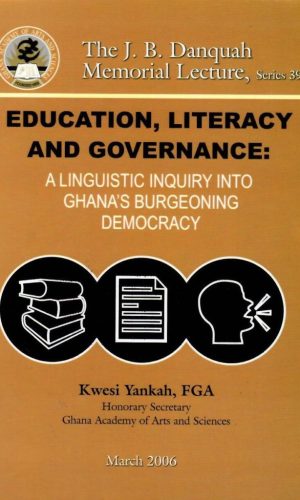
Education, Literacy and Governance: A Linguistic Inquiry into Ghana’s Burgeoning Democracy (The J.B. Danquah Memorial Lecture, Series 39; 2006)
Lectures delivered by Professor Kwesi Yankah. Delivered in March, 2006.
Lecture 1: Free Speech, Censorship and the Language Dilemma in Public Policy
Lecture 2: Krobo Edusei and the Paradigm of Street Wisdom in Contemporary Governance
Lecture 3: The Tongue, The Thumb and The Ballot Box
₵15.00 -
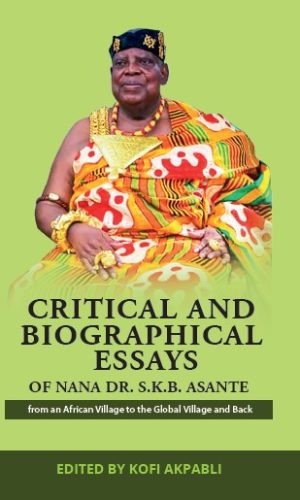
Critical and Biographical Essays of Nana Dr. S.K.B. Asante: From an African Village to the Global Village and Back (Hardcover)
Few Ghanaians of any generation have had a career as long, as varied, and as consequential as Nana S.K.B. Asante’s: government attorney; law teacher; international public servant; constitution framer; adviser to sovereign parties; commercial arbitrator; public intellectual; traditional monarch. Just as impressive is the fact that, in each of these substantial roles, Nana has left a trail of writings. My own first encounter with Nana’s scholarship happened during my time at Yale Law School, his alma mater. As an editor on the law review, I was curious to know whether any Ghanaian had been published by the prestigious journal. My search led me to a fascinating article on Ghanaian property and customary law written by Samuel K.B. Asante in the 1965 volume of the journal. At the time of my discovery, his was the only article by a Ghanaian published in the 100-year history of the journal. I would later discover many more of his academic writings, some of which I assigned to my class in my years as a law teacher.
This book collects in one volume some of Nana’s mostly “non-academic” writings. The essays tell, in characteristically fine prose rich in biography and history, the story of an intellectual-technocrat keen to use his wealth of knowledge to address contemporary problems of development and to put that expertise in the service of his country–and of the developing world at large. The publication of this selection of Nana S.K.B. Asante’s writings, in the 90th year of his life, is a monumental accomplishment and a befitting capstone of a long and distinguished career.
PROF. H. KWASI PREMPEH
Executive Director of Ghana Center for Democratic DevelopmentThe incredibly rich collection of writings by the eminent international lawyer, scholar, respected global development expert and prominent traditional ruler, Nana S.K.B Asante, takes the reader on a remarkable journey of nearly seven decades of illumination. His vivid experiences, enormous achievements and witty recollections reveal the remarkable growth of a curious mind and a disciplined intellectual dedicated ultimately to the service of humanity from his native village to the global village. In characteristic modesty, Nana claims not to be a historian, but this book is a historical gold mine filled with nuggets of analysis on the evolution of education, law, science, social policy, public service, constitutional development, nation building and chieftaincy in Ghana, enriched with valuable insights into the solid contributions of illustrious men and women. His penetrating and critical analyses of international development cooperation in the fields of investments, energy, water and natural resources in Asia and Africa must be lessons for all developing countries. This rich resource book is highly recommended.
DR. AGNES AKOSUA AIDOO
Former Social Policy Adviser, UN Economic Commission for AfricaThis masterpiece by Nana SKB Asante which narrates his life journey from his hometown at Asokore to Achimota, academia, diplomacy and finally back home is unique, inspiring and educative. The Book covers a broad spectrum of academic disciplines including constitutional law, commercial law, criminal law, international law, chieftaincy, leadership and governance, sociology, history and religions. It provides a vivid account of the constitutional history of Ghana from the author’s personal knowledge. The author who had the singular honour to chair the Committee of Experts which gave birth to Ghana’s 1992 Constitution also held the positions of Solicitor-General and Deputy Attorney-General under different democratic and military governments. Nana SKB Asante has used simple diction to convey his wealth of knowledge, experience and wisdom, acquired from both local and international levels in different capacities to inculcate in his audience the spirit of patriotism. The book is a must read!
JUSTICE DENNIS DOMINIC ADJEI, FGA
Justice of The Court of Appeal₵500.00 -
Some Critical Development Issues Facing Ghana (Proceedings, 2001)
Proceedings, 2001.
Papers included are as follows:
Ideology, Politics, Population and Development – Professor Fred T. Sai
The Nature and Place of Ideology – Professor Kwasi Agyeman
Political Power and Development – Professor Kwasi Ansu-Kyeremeh
Transforming Agriculture – Rev. Kwabena Darko
Transforming Industry in Ghana – Mr. Kwame Pianim
Social Transformation: Education, Culture and Human Development – Professor Miranda Greenstreet
Ensuring a Humane Society – Justice Emile Francis Short
Promoting Culture and Development in Contemporary Contexts – Professor J.H. Kwabena Nketia
₵20.00 -
Law & Religion
Inaugural Lectures
Lectures included in this collection are:
Religion and National Identity: Assessing the Discussion from Cicero to Danquah – Rev. Dr. Kwame Bediako (25 June 1997)
Private Investment and Law in a Developing Economy: Reflections – Dr. Samuel K. Date-Bah (22 January 2002)
The Role of the Judiciary in the Establishment of Democracy in Ghana – Mr. Seth Y. Bimpong-Buta (6 April 1999)
Theology and Culture: An African Perspective – Rev. Peter K. Sarpong (31 October 2002)
₵10.00Law & Religion
₵10.00 -
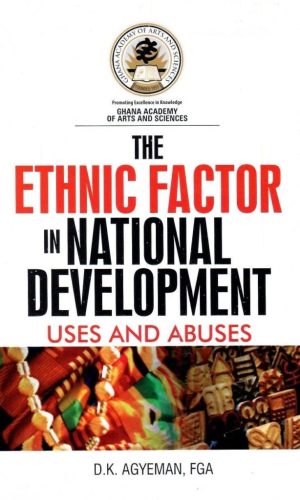
The Ethnic Factor in National Development – Uses and Abuses
Inaugural lecture by Professor Dominic Kofi Agyeman, Professor of Sociology, University of Cape Coast. Delivered on 28 February, 2005.
₵25.00 -
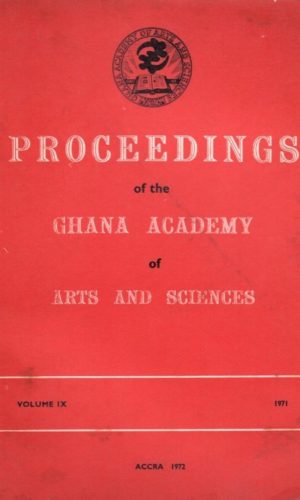
Proceedings of the Ghana Academy of Arts and Sciences & The J.B. Danquah Memorial Lecture, Series 4 (Volume IX, 1971)
Proceedings, 1971. This issue contains the third series of the J.B. Danquah Memorial Lectures delivered by Kwabena Bentsi-Enchill in 1971.
Contents
Address by Hon. Mr. J. Kwesi Lamptey, Minister of Defence and Acting Prime Minister, on the Eleventh Anniversary Dinner of the Ghana Academy of Arts and Sciences held on 21st November 1970
Address by Mr Justice Nii Amaa Ollennu, President of the Academy, at the Eleventh Anniversary Dinner of the Ghana Academy of Arts and Sciences held on 21st November 1970
Institutional Challenges of our Time (4th J.B. Danquah Memorial Lectures) – Kwabena Bentsi-Enchill
Legal Education and National Development – Nii Amaa Ollennu
Some Aspects of Religious Change in Africa – C.G. Baeta
The Role of Mass Communication in the Formation of Public Opinion – C.E. Fiscian
Radio and T.V. in National Development – K.B. Dickson
Computers and the Future of Man – N.R. Smith
The Ghanaian Woman’s Role in Public Life – Gloria Nikoi
Problems of Social Status and Education for the Ghanaian Woman – Susan de Graft-Johnson
The Ghanaian Woman’s Responsibilities in the Home – Florence A. Dolphyne
₵20.00 -
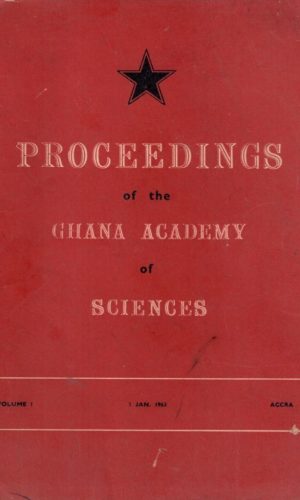
Proceedings of the Ghana Academy of Arts and Sciences (Volume I, 1963)
Proceedings, 1963. First publication.
Contents
Editorial Note
Foreword – by the President of the Academy, Osagyefo Dr. Kwame Nkrumah
The Role of the Physical Sciences in the New Ghana – Professor F.G. Torto
The Role of Medicine in our Changing Society – Dr. S.R.A. Dodu
The Role of Philosophy in the New Republic of Ghana – Dr. C.A. Ackah
The Place of Law in the Republic of Ghana – Justice Sir Arku Korsah
Education for a Place in the World – Sir Sydney Caine
The Nature of Things – Professor J.A.K. Quartey
Science in Modern Society – Professor Lord Alexander Todd
₵20.00 -
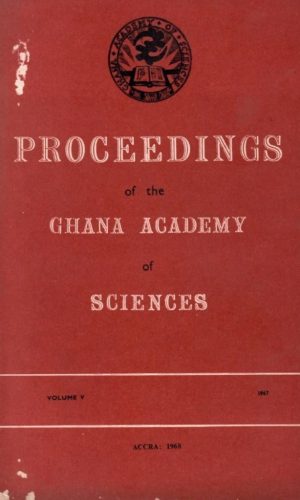
Proceedings of the Ghana Academy of Arts and Sciences (Volume V, 1967)
Proceedings, 1967.
Contents
A Message from His Royal Highness Prince Philip, the Duke of Edinburgh, Patron of the Academy of Arts and Sciences
Seventh Anniversary Dinner Address – Professor E.A. Boateng
Towards a National Science Policy – Professor D.A. Bekoe
The New University of Science and Technology in Developing Countries – Professor Kankam Twum-Barima
The Role of the Humanities in a Developing Country – Professor A.A. Kwapong
International Co-operation in Hydrology – Professor A. Volker
The Structure of Some Mitragyna Alkaloids – Professor A.N. Tackie
Oviposition and Breeding Habits of the Simulidae in Relation to Control Practices – Dr. Leticia E. Obeng
₵20.00 -
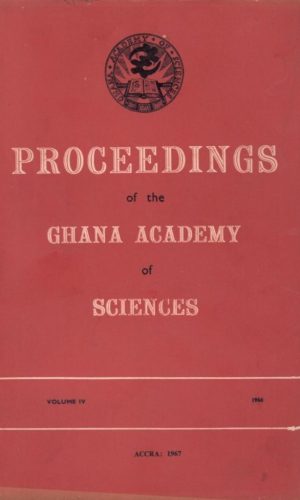
Proceedings of the Ghana Academy of Arts and Sciences (Volume IV, 1966)
Proceedings, 1966.
Contents
Making the Community Healthy – Dr. Fred T. Sai
Medical Education in a Developing Country (Ghana) – Professor C.O. Easmon
Industrial and Technological Possibilities in Ghana during the Seven-Year Development Plan Period – Mr. J.E. Cudjoe
Some Ideas on the Organization of Scientific Research in Developing Countries – Professor A. Raid Tourky
Towards Comprehensive Water Resource Development in Ghana – Mr. E. Lartey
And What About Religion? – Rev. Professor C.G. Baeta
Politics and Education – Mr. Geoffrey H.C. Bing
Biochemistry in Hungary – Professor Bruno F. Straub
Progress of Science in Uzbekistan – Dr. Ubai Arifovich Arifov
₵20.00 -
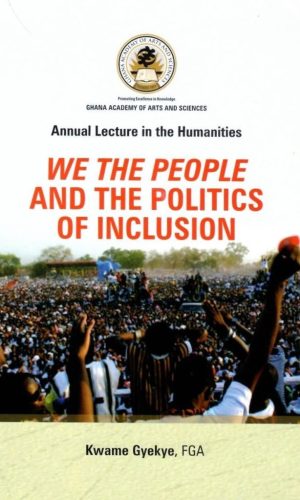
We the People and the Politics of Inclusion (Annual Lecture in the Humanities)
Lecture delivered by Professor Kwame Gyekye, Emeritus Professor of Philosophy, University of Ghana and Scholar-in-Residence, Ashesi University (2010/2011). Delivered on 24 September 2013.
“The words of the preamble of constitutions are emphatic on the centrality of the status of the people in the political order that was expected to be established by these constitutions. The self-referential phrase – We the People – mandates, without a shadow of doubt, a political system that is to be an inclusive system. For, without the politics of inclusion, that self-referential phrase becomes drained of real significance. It is the politics of inclusion, as interpreted in this lecture, that will, beyond representation, give adequate effect to and practical translation of the notion of the constitutional phrase: We the People.”
₵25.00