-
Nyakyusa-English-Swahili & English-Nyakyusa Dictionary
Unhappy with the policy of using English as the medium of instruction in secondary schools in Tanzania which left his students bewildered, a Norwegian volunteer teacher in Ipinda, Tukuyu, south western region of Tanzania decided that his students would probably cope with the foreign language only after they were grounded first in the structure of their own languages — Nyakyusa and Swahili. As a trilingual dictionary was not available, he set out to compile one and this well-produced dictionary is the product. Words, examples and usages are included.
₵75.00 -
The African Writers’ Handbook
Available from 27 June 2022
African Books Collective and the Dag Hammarskjold Foundation organised the African-Writers Publishers Seminar in Tanzania in 1998. Major African writers and publishers hammered out a ‘New Deal’ for relations between the two.
This practical manual includes the ‘New Deal’ statement, and carries forward the work of the seminar. Intended for the aspiring or not yet established creative writer, the answers are given on how to get published, how publishing works, relations with publishers, and how to find resources. With an introduction by Niyi Osundare, the book is in two parts. First, respected African writers and publishers contribute their experiences and perspectives on writing and publishing in Africa — Dapo Adeniyi, Walter Bgoya, Henry Chakava, Cyprian Ekwensi, Taban lo Liyong, Kole Omotoso, Onsonye Tess Onwueme, Femi Osofisan, Niyi Osundare and the late Ken Saro-Wiwa, Yvonne Vera and Paul Tiyambe Zeleza.
A massive amount of practical information and resource materials is given on prizes, writers’ organisations, magazines, vanity and self-publishing, literary agents, censorship, book fairs, resources for writers on the Internet and more. James Currey, Mary Jay, Michael Norton and Hans Zell also contribute.
‘…A veritable mine of advice and practical information and also experiences and ideas, a reference work of great quality…’ — Takam Tikou, No 8, 2000
₵180.00The African Writers’ Handbook
₵180.00 -
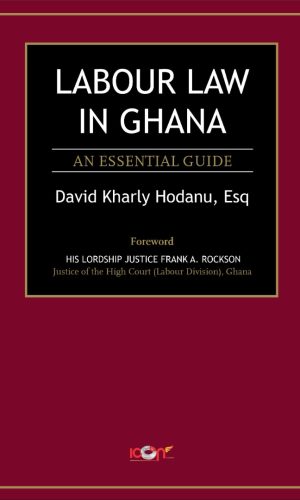
Labour Law in Ghana: An Essential Guide
This text is specifically designed to provide an essential guide to the labour law of Ghana. It is a very comprehensive text, covering all aspects of this area of the law, including the distinction between contract of service and contract for services, formation of the contract of employment, termination of the contract of employment, the rights and duties of employers and workers, dismissal of an employee, the distinction between the terms ‘termination’ and ‘dismissal’, as used in the context of employment, strikes as legitimate weapons in the hands of employees/workers and lockouts as legitimate weapons in the hands of employers, occupational health and safety, retirement and pensions and workmen’s compensation.
The author presents the material in a very simple, straightforward and logically coherent manner and this makes reading the text very fascinating. It is an essential resource for all those seeking to get to grips with this fascinating area of law. Lawyers, Judges, HR Practitioners, Trade Union Leaders, Employers and Workers or Employees will find this text an invaluable resource. Lecturers and students of labour law will also find this text very useful as it fully and thoroughly covers the syllabus requirements of the LLB Laws, BA Human Resource Management, MBA Human Resources and related courses.
₵500.00 -
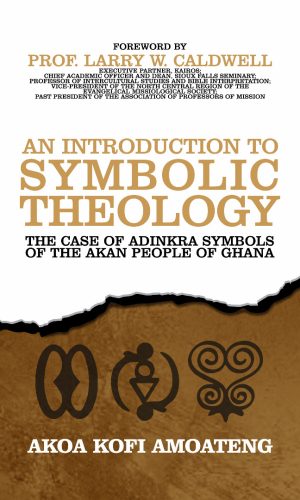
An Introduction to Symbolic Theology: The Case of Adinkra Symbols of the Akan People of Ghana
Akoa Kofi Amoateng strongly believes that Jesus’ incarnation into Jewish-specific culture and humanity as God’s communication to the world (Hebrews 1:1-3), implies the theological and understanding that God wants culture-specific peoples around the world to identify and relate to Him from their cultural and historic experiences and backgrounds. He, therefore, submits that theology and hermeneutics must be both contextual and rooted in ethnic epistemological realities. Akoa, therefore, calls for ethnothelogy and ethnohermeneutics, believing that, generally, there is nothing like one theological jackets that fits all peoples.
This work is a masterpiece and a paradigm shift into offering how peoples’ theologies and indigenous hermeneutical enterprises can be constructed in contextualization for the different peoples of the world.
“Amoateng draws attention to the critical role symbols play for African theology. He bemoans the neglect of the early missionaries to the symbolic realm which has left a paucity of theological reflections on the Adinkra symbols. He uses this lacuna to highlight symbolic theology within the wider purview of ethnotheology, which some scholars are calling ethnohermeneutics. The Adinkra symbols can thus be analyzed within the broader lenses of Africa’s rich oral history, especially if we understand orality much larger than verbal utterances, but to include symbols that speak even when words are absent.” — Gregg Okesson, Ira Galloway and D.M. Beeson Chair of Leadership Development and Evangelism; Dean, E. Stanley Jones School ofWorld Mission and Evangelism; Presidential Envoy and Director of Global Partnerships, Asbury Theological Seminary
₵100.00 -
Kwahu State Book: Asaase Aban (Hardcover)
Information captured in the Kwahu State Book entails the history of Kwahu paramountcy including the five divisions of the Kwahu Traditional Area namely Adonten, Nifa, Benkum, Kyidom and the Gyase division; with histories of royal families, towns and villages under the divisions mentioned are well captured. Towns captured include Abene, Abetifi, Obo, Aduamoa, Pepease, Atibie, Bokuruwa, Nkwatia, Obomeng, Bepong, Asakraka, Kwahu Tafo, Pitiko, Akwasiho, Mpraeso, Twenedurase, Kotoso, Jejeti, Oframase, Awenare, Nkorkoor (Nkawkaw), Nteso, Tease, Kwahu Praso, just to mention few. The book also presents histories of the Zongo Community of Kwahu, the Okwawu Football Club, churches, schools and profiles of the prominent personalities (the Kwahu Golden members) of Kwahu.
The Kwahu State Book has fourteen (14) sections with each segmenting several topics and sub-topics about the history and cultural practices of the Kwahu Traditional Area. Other information in the book include chronology of chiefs and genealogy (family tree) of all the royal families. All of these have been codified into a single voluminous book of over 2,800 pages. It is the first of its kind in Ghana and sub-Saharan Africa.
All of these have been codified into a single voluminous book of over 2,800 pages. It is the first of its kind in Ghana and sub-Saharan Africa.
₵1,300.00 -
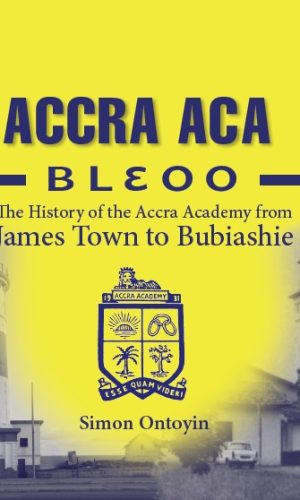
Accra Aca Blɛoo: The History of the Accra Academy from James Town to Bubiashie (Hardcover)
Accra Aca Bleoo – the first comprehensive history book on the Accra Academy – captures nine decades of the school’s history, including the most epic events and pivotal moments. It takes the reader through the life journeys of the founders and those who believed in their dream to educate the underprivileged youth of the Gold Coast. It also recounts the aspirations and achievements of successive administrations of the school and how they overcame the challenges of their time and influenced the character of their students.
The book brings to light several unknown facts about the Accra Academy and examines the educational policies that have influenced its development and growth.
It is not only informative and educative but also entertaining, as it is interspersed with interesting stories and several pictures that will undoubtedly take the minds of alumni back to the good old days and give other readers a perspective into how life in the school has evolved.
This book is the outcome of many hours of personal interviews and research, and is intended for anyone interested in the history of education in Ghana and what has made the Accra Academy what it is today.
₵200.00 -

Baiblo aloo Ŋmalɛ Krɔŋkrɔŋ Lɛ: New Revised Ga & English Standard Version Diglot (Ga/English Bible)
Bible in Gã and English together in one volume, displayed side-by-side on the page, with one side written in Ga and one side written in English.
₵225.00 -

Twerɛ Kronkron: New Revised Asante Twi & English Standard Version Diglot (Asante Twi/English Bible)
Bible in Asante Twi and English together in one volume, displayed side-by-side on the page, with one side written in Asante Twi and one side written in English.
₵225.00 -
Good News Bible: The Interactive Youth Edition (Hardcover)
The Good News Bible Youth Edition is created in partnership between Bible Society and Youth for Christ.No matter how much you’ve read the Bible before, or how connected to God you feel, this book is for you.Young people helped us put this Bible together, and it features:- Links to 30 videos (also available on YouTube) unpacking themes found in the Bible.
- Hundreds of interactive elements throughout the Bible to inspire you to dig deeper.
- A full-page introduction to each book of the Bible, showing what its all about and how it is fits into the bigger story.
- Forty-eight (48) extra pages of key things to know about the Bible, help with tough topics, and journaling space
₵51.19 -
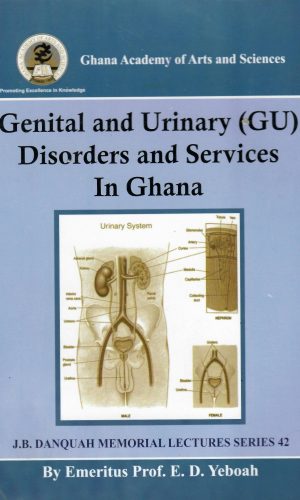
Genital and Urinary (GU) Disorders and Services in Ghana (The J.B. Danquah Memorial Lecture, Series 3; 2009)
J.B Danquah Memorial Lectures Series 42. Delivered by Emeritus Professor E.D. Yeboah in 2009.
₵34.13 -
Introduction to the Law of Torts in Ghana (Hardcover)
This book attempts to state the Law of Torts as it should apply in the Ghana legal stem. Article I I of the 1992 Constitution recognises the common law principles as they were received from the Anglo-American common law tradition as part of the Laws of Ghana. Section 54 of the Courts Act, 1993 (Act 459) provides that our courts may in the determination of any issue arising from the common law, adopt, develop and apply remedies from any other legal system based on the Anglo-American legal tradition.
In many contemporary common law countries, for example the UK and the USA, however, there has been an explosion of statutory interventions in the common law. This is reflected in the discussions of the common law principles in the recent editions of textbooks written in those countries. Unfortunately, these statutes are not “statutes of general application,” as this phrase is used and understood in the Ghana legal system. The admixture of these statutes and the common law in these countries makes the isolation of the parts of those books, which are helpful to our causes in Ghana, a major challenge.
This book attempts to isolate what is usable from what is not. The hope of the author and the publishers is that the reader, whether a practitioner or student, will find the principles of torts law, as stated in the book, devoid of the statutory contaminations.
₵300.00 -
The Alchemy of Social Justice: Directive Principles of State Policy
FREEDOM AND JUSTICE: These twin concepts encapsulate the Ghanaian Dream which is the overarching national manifesto in aid of a project to transform the Ghanaian political State into a free and just society. The object of the transformation is to secure social order through the institution of social justice which, when fueled or energised by patriotism and charity, creates the enabling environment for security and development.
Political philosophy, in the context of the DPSP, attempts to answer the question as to what the best society for the people of Ghana is. The framers of the Constitution, 1992 answered the question through the provision of the DPSP. For their part, in interpreting and applying the DPSP, the Judiciary must perpetually answer the political philosophical question whether they are in the business of helping to realise a free and just society.
The society envisaged is the subjective meaning of the political state, the subjective meaning of the relation between the citizen and the political state, and the subjective meaning of freedom and justice as perceived by the citizens of the State. The society is ideational; it has the potential to be attitudinal. In a sense, the State can be visualised as the physical edifice of a symbolic society. The nature of the subjective meaning as perceived by the citizens in the form of a virtual society determines the health of the political state; and one of the main purposes of the DPSP is to control and determine the nature of the virtual society.
The author’s three approaches to the DPSP depend on the question that the interpreter poses and seeks to answer. The theoretical approach involves freewheeling and fundamental questions that are unrestricted by any enactment or fact situation; the legal approach poses a question that is tethered to an enactment and is, in that regard, restricted by the meaning and context of the relevant enactment; and, the strategic approach deals with society-dependent questions involving a particular fact situation (an event) and an enactment.
The author suggests that the term enforceability be reserved for the fact that the principle is binding and worthy or deserving of a judicial declaration; that the possibility of molding orders following the declaration is a question of justiciability; and that the term justiciability should be reserved for non-enforcement on account of prudence in the design of orders.
₵580.00