-
-
-
Knowledge Management and Network for Capacity Development: A Focus on Institute of Directors Ghana (Hardcover)
The book examines how directors in Ghana share tacit knowledge and experiences on the board. The rationale is that there is the tendency for boards In Ghana to lose tacit knowledge, experiences, skills and particularly up to date knowledge required to inform their decision making due to lack of practical knowledge management system for directors’ capacity development. The focus is to examine how the Institute of Directors Ghana (IODG) can manage knowledge with the view to tackling challenges leading to losing tacit knowledge, experiences, and skills of boards in Ghana.
The objective is to influence boards of organizations in Ghana to recognize and initiate knowledge management practices, as well as adopt policies that support the application of practical knowledge management systems and interpersonal networks for directors’ capacity development in Ghana.
The results revealed the existence of records of minutes of meetings indicating a latent existence of knowledge management system within organizations but not formalized as a knowledge management system. Also, significantly missing was technology for knowledge transformation.
The book recommends knowledge management systems backed by technology for acquiring and sharing directors’ knowledge for successful knowledge transformation.
₵100.00 -
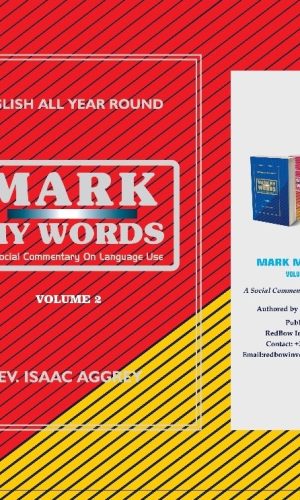
Mark My Words (Volume 2)
This book, MARK MY WORDS, has been born out of a passionate desire to draw attention to the importance of words, and more importantly, the appropriate use of words. The book is also intended to remind users of the English language to take personal responsibility for the words we use; that has largely determined the title of the book, particularly the use of “MY” – the possessive form of ‘I’.
It must be emphasized that this material is not an attempt to produce a typical book on English grammar; it is an effort to provide a social commentary on language use. This has obviously determined and underlined the focus and style of presentation
₵50.00Mark My Words (Volume 2)
₵50.00 -
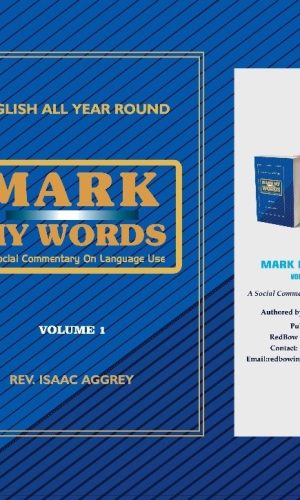
Mark My Words (Volume 1)
This book, MARK MY WORDS, has been born out of a passionate desire to draw attention to the importance of words, and more importantly, the appropriate use of words. The book is also intended to remind users of the English language to take personal responsibility for the words we use; that has largely determined the title of the book, particularly the use of “MY” – the possessive form of ‘I’.
It must be emphasized that this material is not an attempt to produce a typical book on English grammar; it is an effort to provide a social commentary on language use. This has obviously determined and underlined the focus and style of presentation
₵50.00Mark My Words (Volume 1)
₵50.00 -
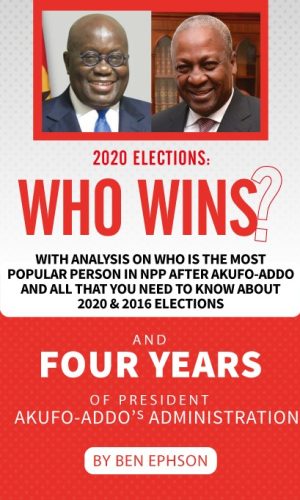
2020 Elections: Who Wins?
Ben Ephson gives us an in-depth analysis on who wins the 2020 Elections. This books also captures the most popular person in the NPP after Akufo-Addo and all we need to know about the 2016 & 2020 Elections.
₵250.002020 Elections: Who Wins?
₵250.00 -

Courting Greatness: Non-negotiable Elements in the Dowry From Small Beginnings to Remarkable Heights
COURTING GREATNESS provides practical guidelines on how to optimize your potential.
₵30.00 -
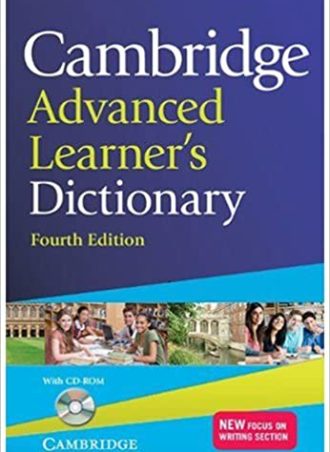
Cambridge Advanced Learner’s Dictionary
A fully updated edition of the best-selling Cambridge Advanced Learner’s Dictionary. This paperback edition is ideal for advanced (C1-C2) learners of English and contains up-to-date vocabulary, including words from the areas of technology, media, language, society, and lifestyle, plus important words for academic study. With over 140,000 words, phrases, meanings, and examples, hundreds of pictures and illustrations, clear definitions and a new ‘Focus on Writing’ section, the dictionary is perfect as a reference tool and as a study companion. Informed by the Cambridge International Corpus and correlated to English Vocabulary Profile, it is also ideal for exam preparation. The CD-ROM contains the complete dictionary and recordings in British and American English.
₵260.00 -
Baebor (Medium Size, Fante Bible)
The Holy bible translated into Fante
₵55.00 -
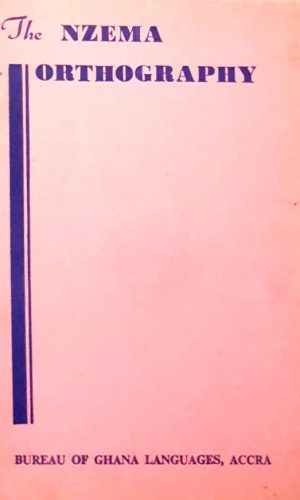
The Nzema Orthography (Nzema)
Nzema is spoken mainly in the extreme West of the Western Region. It is spoken, too, by about half the population in the mining areas.
Nzema is a tonal language and changes in meaning may be brought about by tonal differences.
It is not expected that you can learn Nzema through this little guide book, but it is hoped that it will help you find your way about with minimum difficulty.
₵13.00 -

The Usborne Illustrated Dictionary (Hardcover)
Age Range: 8+ years
A comprehensive dictionary with over a thousand colour illustrations, over 10,000 entries and 25,000 straightforward definitions with part of speech indicators, example sentences and pronunciation guides for tricky words. * Also contains information on parts of speech, the conventions of written English and a brief history of the English language. * Fully revised and updated for 2014 and beyond, with new words added and redundant words removed. * An essential and great value home or school reference book perfect for children beginning their SAts.
₵50.00 -
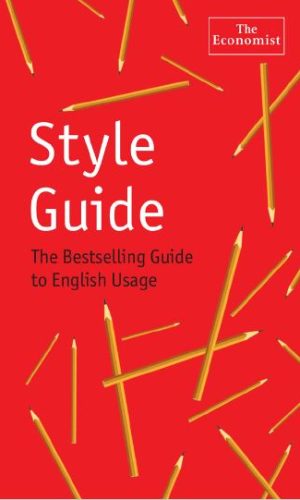
The Economist Style Guide: A Concise Guide for All Your Business Communications
An authoritative reference on clear, concise writing
Witty, concise, and enlightening, The Economist Style Guide is an authoritative resource for all your written communications. Based on the style guide used by the writers for the renowned international business journal acclaimed for its crisp, clear writing, this practical guide offers unerring guidance on grammar, usage, and style in business communications.
Providing sage advice on writing in general (“Use the language of everyday speech”; “Long paragraphs, like long sentences, confuse the reader”; “Don’t overdo the use of don’t, isn’t, can’t, won’t, etc.”), the Guide clarifies such perpetual questions as: compare with (emphasizes differences) and compare to (similarities) different — used with from, not to or than affect (to have an influence on) and effect (to accomplish).
There’s also invaluable information on international business terms and abbreviations, political and geographical facts, units of measurement, currencies, trade classifications, differences between American and British English, and much more.
In today’s high-speed business environment, the ability to communicate clearly, accurately, and concisely is essential to professional success. The Economist Style Guide has become the reference of choice for business people everywhere who need practical, authoritative advice on how to improve their written communications.
Developed from the style guide used by those who work for The Economist—the international business journal renowned for its writing excellence—this handy resource provides easily accessible answers to the numerous questions of usage, grammar, and style that frequently arise in the course of a business day.
Offering invaluable guidance on the principles of good writing, The Economist Style Guide defines commonly misused words and expressions, and explains the correct use of punctuation, abbreviations, capital letters, and more —all illustrated with an abundance of amusing examples.
As an aid to those engaged in international business, the Guide supplies a wealth of handy reference material on such areas as units of measurement, political and geographical terms, currencies, trade classifications, differences between American and British English, and much more.
Whether you are dashing off a quick e-mail message or preparing a formal report, The Economist Style Guide will help you hone your language skills and sharpen all your business communications. It is an indispensable aid to clarity and precision that will prove its value again and again as the reference book you’ll keep within reach whenever you write.
₵80.00