-
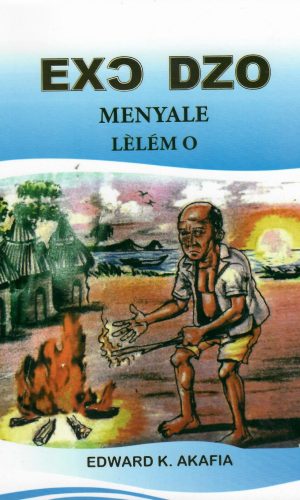
Exɔ Dzo Menyale Lẽlẽm o (Eʋe)
An anthology of Eʋe poems, including many inspiring revolutionary poems.
₵25.00 -
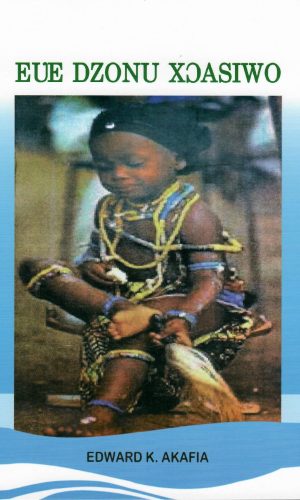
Eʋe Dzonu Xɔasiwo (Eʋe)
An anthology of very inspiring Eʋe poems.
₵24.00Eʋe Dzonu Xɔasiwo (Eʋe)
₵24.00 -
-
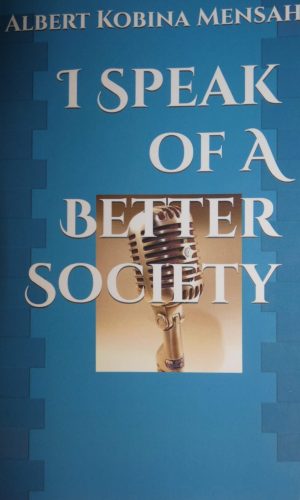
I Speak of A Better Society
In this book, I Speak of a Better Society, I argued for a better society in Africa. A better society is coined as one where individuals therein could achieve their full potential. The African with the dream to be like anyone in Europe or North America. The African with a higher loyalty to truth, integrity, values, and good leadership. The African who needs a level-playing field to compete with the rest of the world. And, the African who has passion to change their world because the status-quo is wrong. In a better society, there is a fair play. In creating such society, additional values such as pragmatism, meritocracy, honesty, equity, and putting humanity topmost priority, count and matter.
The book advances my personal experiences, ideas, arguments, and opinions for creating a better society fair and just for all citizens in Africa. I argued that Africa is not poor and that we could create a better society for the indigenes therein, if we could have the right leadership in place and when we the citizens could change our attitudes as people.
₵75.00I Speak of A Better Society
₵75.00 -
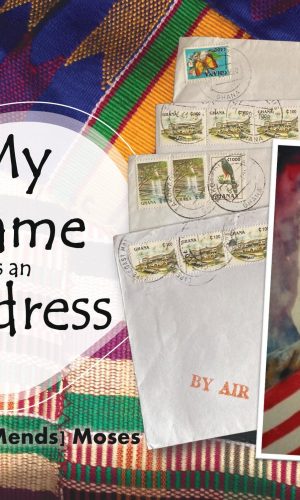
My Name is an Address (Hardcover)
Age Range: 8 – 12 years
You are not lost! You are not alone! A GPS system navigates you to where you are going, but your name could lead to what you are looking for. What’s in a name?
Ekuwah Mends uses the alphabet letters to answer that question. She opens a window into her family, history, culture, language, geography, and more. Look through Ekuwah’s actual family photos, Mother’s artwork, and Father’s artifact collection.
My Name is an Address comes to life and touches your heart. Exit the story by finding your own Akan name. Also, return when you need to feel connected. Ultimately, be inspired to find your own address.
₵135.00 -
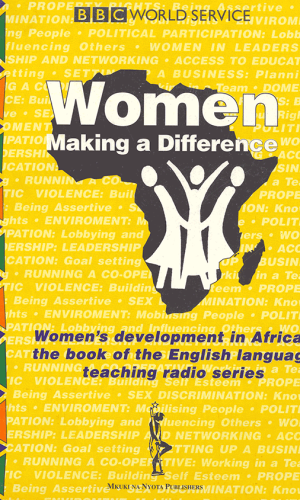
BBC World Service: Women Making a Difference – The Book of the English Language Teaching Radio Series for Africa
Women Making a Difference, a radio series and a book which explores the issues confronting women in Africa. It is a collaboration between the BBC World
₵60.00 -
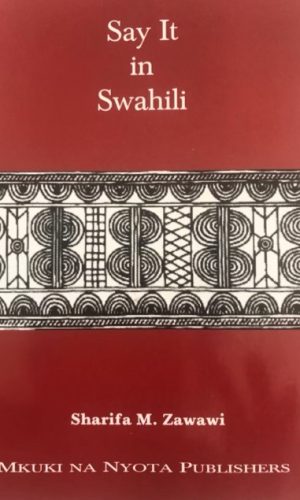
Say It in Swahili
Contains over 1,000 useful sentences and phrases for travel or everyday living abroad: food, shopping, medical aid, courtesy, hotels, travel, and other situations. Gives the English phrase, the foreign equivalent, and a transliteration that can be read right off. Also includes many supplementary lists, signs, and aids. All words are indexed.₵50.00Say It in Swahili
₵50.00 -
Swahili-English Pocket Dictionary
A concise and portable dictionary developed by two experienced and well respected teachers of Swahili. In this work they have taken into account not only the difficulties which non-Swahili speakers from many different language backgrounds have in learning the language, but also the importance of making Swahili equivalents of English words, correspond to those of the best speakers of Swahili.The English-Swahili Pocket Dictionary will be of benefit to English speakers who are learning Swahili, while Swahili speakers who are learning English will also find it invaluable.₵50.00 -
English-Swahili Pocket Dictionary
A concise and portable dictionary developed by two experienced and well respected teachers of Swahili. In this work they have taken into account not only the difficulties which non-Swahili speakers from many different language backgrounds have in learning the language, but also the importance of making Swahili equivalents of English words, correspond to those of the best speakers of Swahili.The English-Swahili Pocket Dictionary will be of benefit to English speakers who are learning Swahili, while Swahili speakers who are learning English will also find it invaluable.₵50.00 -
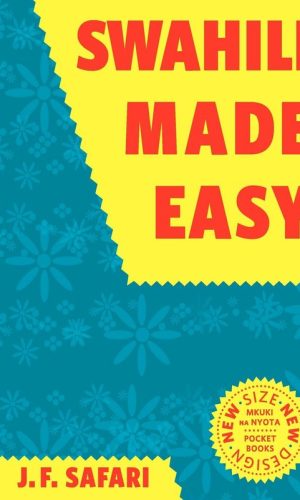
Swahili Made Easy: A Beginner’s Complete Course
This handy book is a beginner’s complete course in the Swahili language, designed especially for foreigners. The book is a result of the author’s many years of teaching experience. It is divided into two parts: part one covers pronunciation; Swahili greetings and manners; classification of nouns; adjectives, verbs, adverbs, etc. in twenty-eight lessons and thirty-six exercises. part two includes a study of Swahili usage in specific situations (e.g. at home, in the market, on the road, at the airport, etc.); eleven further lessons and thirteen exercises; the key to the exercises in Parts One and Two; and a Swahili-English vocabulary of words used in the book.
₵50.00 -
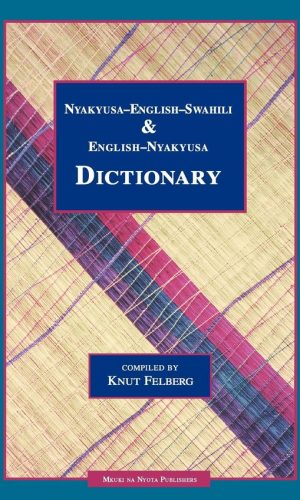
Nyakyusa-English-Swahili & English-Nyakyusa Dictionary
Unhappy with the policy of using English as the medium of instruction in secondary schools in Tanzania which left his students bewildered, a Norwegian volunteer teacher in Ipinda, Tukuyu, south western region of Tanzania decided that his students would probably cope with the foreign language only after they were grounded first in the structure of their own languages — Nyakyusa and Swahili. As a trilingual dictionary was not available, he set out to compile one and this well-produced dictionary is the product. Words, examples and usages are included.
₵75.00 -
From Dar es Salaam to Bongoland: Urban Mutations in Tanzania
The name Dar es Salaam comes from the Arabic phrase meaning house of peace. A popular but erroneous translation is ‘haven of peace’ resulting from a mix-up of the Arabic words “dar” (house) and “bandar” (harbour). Named in 1867 by the Sultan of Zanzibar, the town has for a long time benefitted from a reputation of being a place of tranquility. The tropical drowsiness is a comfort to the socialist poverty and under-equipment that causes an unending anxiety to reign over the town. Today, for the Tanzanian, the town has become Bongoland, that is, a place where survival is a matter of cunning and intelligence (bongo means ‘brain’ in Kiswahili). Far from being an anecdote, this slide into toponomy records the mutations that affect the links that Tanzanians maintain with their principal city and the manner in which it represents them.
This book takes into account the changes by departing from the hypothesis that they reveal a process of territorialisation. What are the processes – envisaged as spatial investments – which, by producing exclusivity, demarcations and exclusions, fragment the urban space and its social fabric? Do the practices and discussions of the urban dwellers construct limited spaces, appropriated, identified and managed by communities (in other words, territories)? Dar es Salaam is often described as a diversified, relatively homogenous and integrating place. However, is it not more appropriate to describe it as fragmented?
As territorialisation can only occur through frequenting, management and localised investment, it is therefore through certain places – first shelter and residential area, then the school, daladala station, the fire hydrant and the quays – that the town is observed. This led to broach the question in the geographical sense of urban policy carried out since German colonisation to date. At the same time, the analysis of these developments allows for an evaluation of the role of the urban crisis and the responses it brings.
In sum, the aim of this approach is to measure the impact of the uniqueness of the place on the current changes. On one hand, this is linked to its long-term insertion in the Swahili civilisation, and on the other, to its colonisation by Germany and later Britain and finally, to the singularity of the post-colonial path. This latter is marked by an alternation of Ujamaa with Structural Adjustment Plans applied since 1987. How does this remarkable political culture take part in the emerging city today?
This book is a translation of De Dar es Salaam à Bongoland: Mutations urbaines en Tanzanie, published by Karthala, Paris in 2006.
₵130.00