-
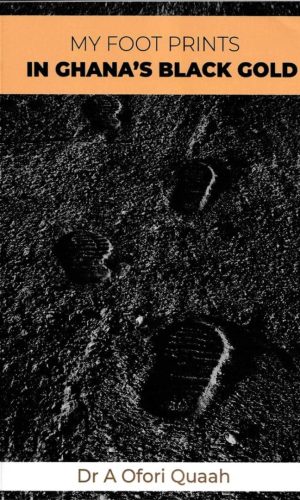
My Footprints in Ghana’s Black Gold
This memoir — part historical and part autobiographical — traces the author’s involvement with the final phase of petroleum exploration in Ghana, a journey that took over a century, beginning with the first onshore well in 1896. It has been a most interesting journey, with many twists and turns.
In the early days of the existence of the Ghana National Petroleum Corporation, there were various myths and half-truths about the presence or absence of commercial quantities of oil and gas in the basins of the Ghana.
- Nigeria was draining Ghana’s oil and that all that was required was for Ghana to buy powerful machines and begin to pump and drain her own
- Ghana would never find oil until the gods of Nzemaland and the Volta Region had been pacified
- The GNPC Model Production Sharing Agreement was too stringent on contractors
A major seismic interpretation of the Cape Three Points sub-basin of the Western Region, in 1992, would turn out to be the watershed of this new brave phase of exploration in Ghana.
The book was finally launched in Ghana in April 2022.
Hopefully, going to the heart of the matter should help future generations of ordinary Ghanaians, politicians and explorationists understand what it took to make Ghana a petroleum producing country, just in case the country was afflicted by the “Dutch disease.”
₵120.00 -
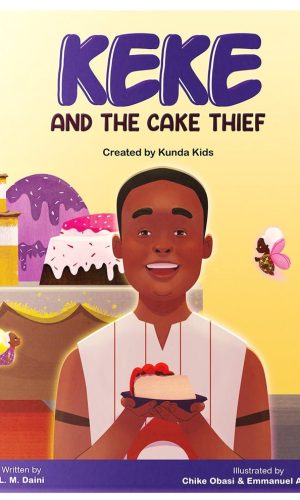
Keke And The Cake Thief
Age Range: 4 – 8 years
Reading Level: 2 – 3
Keke and the Cake Thief, written by L.M Daini and illustrated by Chike Obasi and Emmanuel Adepitan. Suitable for ages 4-8 years.
In this story, there’s a cake thief in the kingdom and the king is getting very upset. Keke’s love for cakes makes him the best person to help track down the elusive cake thief and restore peace in the king’s kitchen!
This is a fun and beautifully illustrated modern African fairy tale, perfect for story time at home and in the classroom. A must-have for every child’s library and an excellent gift for all occasions, birthdays, Christmas, World Book Day, Black History Month and Kwanzaa.
₵55.00Keke And The Cake Thief
₵55.00 -
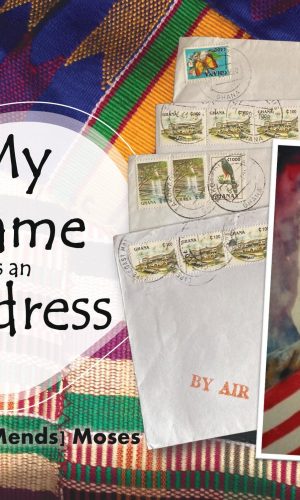
My Name is an Address (Hardcover)
Age Range: 8 – 12 years
You are not lost! You are not alone! A GPS system navigates you to where you are going, but your name could lead to what you are looking for. What’s in a name?
Ekuwah Mends uses the alphabet letters to answer that question. She opens a window into her family, history, culture, language, geography, and more. Look through Ekuwah’s actual family photos, Mother’s artwork, and Father’s artifact collection.
My Name is an Address comes to life and touches your heart. Exit the story by finding your own Akan name. Also, return when you need to feel connected. Ultimately, be inspired to find your own address.
₵135.00 -
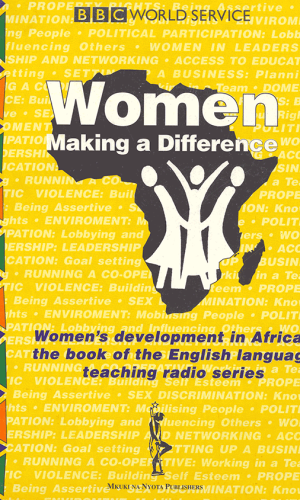
BBC World Service: Women Making a Difference – The Book of the English Language Teaching Radio Series for Africa
Women Making a Difference, a radio series and a book which explores the issues confronting women in Africa. It is a collaboration between the BBC World
₵60.00 -
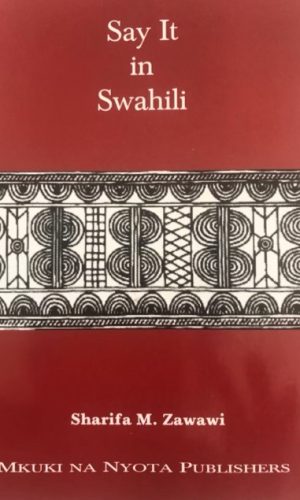
Say It in Swahili
Contains over 1,000 useful sentences and phrases for travel or everyday living abroad: food, shopping, medical aid, courtesy, hotels, travel, and other situations. Gives the English phrase, the foreign equivalent, and a transliteration that can be read right off. Also includes many supplementary lists, signs, and aids. All words are indexed.₵50.00Say It in Swahili
₵50.00 -
Swahili-English Pocket Dictionary
A concise and portable dictionary developed by two experienced and well respected teachers of Swahili. In this work they have taken into account not only the difficulties which non-Swahili speakers from many different language backgrounds have in learning the language, but also the importance of making Swahili equivalents of English words, correspond to those of the best speakers of Swahili.The English-Swahili Pocket Dictionary will be of benefit to English speakers who are learning Swahili, while Swahili speakers who are learning English will also find it invaluable.₵50.00 -
English-Swahili Pocket Dictionary
A concise and portable dictionary developed by two experienced and well respected teachers of Swahili. In this work they have taken into account not only the difficulties which non-Swahili speakers from many different language backgrounds have in learning the language, but also the importance of making Swahili equivalents of English words, correspond to those of the best speakers of Swahili.The English-Swahili Pocket Dictionary will be of benefit to English speakers who are learning Swahili, while Swahili speakers who are learning English will also find it invaluable.₵50.00 -
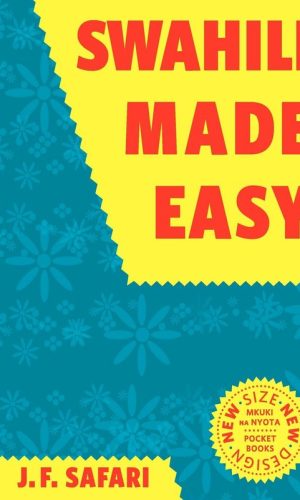
Swahili Made Easy: A Beginner’s Complete Course
This handy book is a beginner’s complete course in the Swahili language, designed especially for foreigners. The book is a result of the author’s many years of teaching experience. It is divided into two parts: part one covers pronunciation; Swahili greetings and manners; classification of nouns; adjectives, verbs, adverbs, etc. in twenty-eight lessons and thirty-six exercises. part two includes a study of Swahili usage in specific situations (e.g. at home, in the market, on the road, at the airport, etc.); eleven further lessons and thirteen exercises; the key to the exercises in Parts One and Two; and a Swahili-English vocabulary of words used in the book.
₵50.00 -
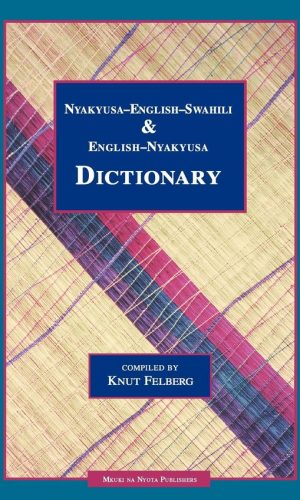
Nyakyusa-English-Swahili & English-Nyakyusa Dictionary
Unhappy with the policy of using English as the medium of instruction in secondary schools in Tanzania which left his students bewildered, a Norwegian volunteer teacher in Ipinda, Tukuyu, south western region of Tanzania decided that his students would probably cope with the foreign language only after they were grounded first in the structure of their own languages — Nyakyusa and Swahili. As a trilingual dictionary was not available, he set out to compile one and this well-produced dictionary is the product. Words, examples and usages are included.
₵75.00 -
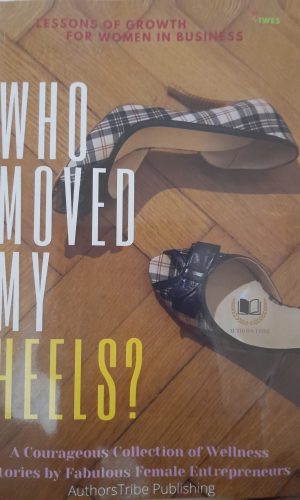
Who Moved My Heels?
This book gives provides a diverse backdrop of females in business from eleven countries. It shares deep insights on how to ignite your purpose and passion.
The “Who Moved My Heels” classic brings 18 businesswomen into the consultation room to share their real, raw struggle of entrepreneurship. This book also collates impactful, heartfelt, valuable lessons that encourage, motivate and strengthen females starting out in business. It is a courageous collection of honest, down-to-earth experiences aimed at warding off doubts that may swerve existing entrepreneurs off-track.
Dr. Abena Asomaning-Antwi partners with prolific authors and rising women such as Kiran Shah, Dr Aloysis Ogle, Arpita Kaul, Cardela Coulson, Dr. Nongnush Ammoury, Georgina Kelly, Arundhati Seigell, Farzana Muhammad, Dr. Venessa Moussa, Lady Charul Jaitly, Priyaa Televvane, Atiyya Dudhat, Dr. Genevieve Duncan, Vyara Tosheva, Dr. Fatima Beena, Lynette Lobo, and Fauza Belts.
₵100.00Who Moved My Heels?
₵100.00 -
From Dar es Salaam to Bongoland: Urban Mutations in Tanzania
The name Dar es Salaam comes from the Arabic phrase meaning house of peace. A popular but erroneous translation is ‘haven of peace’ resulting from a mix-up of the Arabic words “dar” (house) and “bandar” (harbour). Named in 1867 by the Sultan of Zanzibar, the town has for a long time benefitted from a reputation of being a place of tranquility. The tropical drowsiness is a comfort to the socialist poverty and under-equipment that causes an unending anxiety to reign over the town. Today, for the Tanzanian, the town has become Bongoland, that is, a place where survival is a matter of cunning and intelligence (bongo means ‘brain’ in Kiswahili). Far from being an anecdote, this slide into toponomy records the mutations that affect the links that Tanzanians maintain with their principal city and the manner in which it represents them.
This book takes into account the changes by departing from the hypothesis that they reveal a process of territorialisation. What are the processes – envisaged as spatial investments – which, by producing exclusivity, demarcations and exclusions, fragment the urban space and its social fabric? Do the practices and discussions of the urban dwellers construct limited spaces, appropriated, identified and managed by communities (in other words, territories)? Dar es Salaam is often described as a diversified, relatively homogenous and integrating place. However, is it not more appropriate to describe it as fragmented?
As territorialisation can only occur through frequenting, management and localised investment, it is therefore through certain places – first shelter and residential area, then the school, daladala station, the fire hydrant and the quays – that the town is observed. This led to broach the question in the geographical sense of urban policy carried out since German colonisation to date. At the same time, the analysis of these developments allows for an evaluation of the role of the urban crisis and the responses it brings.
In sum, the aim of this approach is to measure the impact of the uniqueness of the place on the current changes. On one hand, this is linked to its long-term insertion in the Swahili civilisation, and on the other, to its colonisation by Germany and later Britain and finally, to the singularity of the post-colonial path. This latter is marked by an alternation of Ujamaa with Structural Adjustment Plans applied since 1987. How does this remarkable political culture take part in the emerging city today?
This book is a translation of De Dar es Salaam à Bongoland: Mutations urbaines en Tanzanie, published by Karthala, Paris in 2006.
₵130.00 -
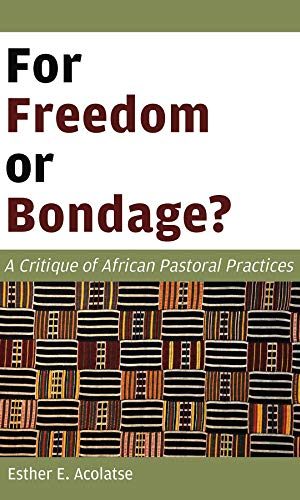
For Freedom or Bondage?: A Critique of African Pastoral Practices
In Ghana today, many people who suffer from a variety of human ills wander from one pastor to another in search of a spiritual cure. Because of the way cultural beliefs about the spiritual world have interwoven with their Christian faith, many Ghanaian Christians live in bondage to their fears of evil spiritual powers, seeing Jesus as a superior power to use against these malevolent spiritual forces.
In For Freedom or Bondage? Esther Acolatse argues that Christian pastoral practices in many African churches include too much influence from African traditional religions. She examines Ghana Independent Charismatic churches as a case study, offering theological and psychological analysis of current pastoral care practices through the lenses of Barth and Jung. Facilitating a three-strand conversation between African traditional religion, Barthian theology, and Jungian analytical psychology, Acolatse interrogates problematic cultural narratives and offers a more nuanced approach to pastoral care.
₵120.00