-
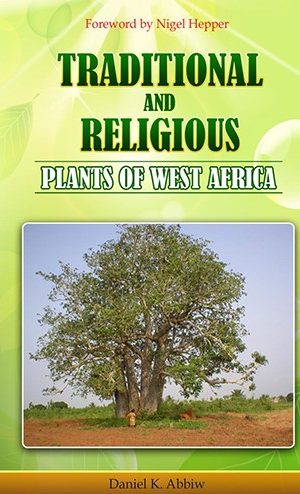
Traditional And Religious Plants in West Africa
The book is a comprehensive coverage of the Traditional and Religious Plants of West Africa. Readers will be fascinated by the information captured in this masterpiece, authored by an academic gem who is well-known in the botany field.
₵75.00 -
-
Introduction to the Law of Torts in Ghana (Hardcover)
This book attempts to state the Law of Torts as it should apply in the Ghana legal stem. Article I I of the 1992 Constitution recognises the common law principles as they were received from the Anglo-American common law tradition as part of the Laws of Ghana. Section 54 of the Courts Act, 1993 (Act 459) provides that our courts may in the determination of any issue arising from the common law, adopt, develop and apply remedies from any other legal system based on the Anglo-American legal tradition.
In many contemporary common law countries, for example the UK and the USA, however, there has been an explosion of statutory interventions in the common law. This is reflected in the discussions of the common law principles in the recent editions of textbooks written in those countries. Unfortunately, these statutes are not “statutes of general application,” as this phrase is used and understood in the Ghana legal system. The admixture of these statutes and the common law in these countries makes the isolation of the parts of those books, which are helpful to our causes in Ghana, a major challenge.
This book attempts to isolate what is usable from what is not. The hope of the author and the publishers is that the reader, whether a practitioner or student, will find the principles of torts law, as stated in the book, devoid of the statutory contaminations.
₵300.00 -
Conflict of Laws in Ghana
Generations of Ghanaian law students, scholars, legal practitioners and judges have engaged with conflict of laws issues in their respective capacities. Regrettably, they have not had access to an authentic Ghanaian treatise on the discipline — a treatise foregrounded in Ghanaian case law and legislation. They have had to rely on foreign treatises (often very dated editions) mainly written by reputed English scholars.
Richard Frimpong Oppong and Kissi Agyebeng have filled this void in the scholarship on Ghanaian law with their sophisticated and skilfully executed work of scholarship: Conflict of Laws in Ghana.
This monograph is a timely publication. We live in a globalised world, a world beset with conflict of laws problems. Increases in cross-border movements of persons and the concomitant cross-border relationships they create, the growth of international commerce and foreign direct investment, ever-increasing international litigation, and international arbitration have all highlighted the importance of conflict of laws as a discipline.
Judges, legal scholars, legal practitioners, law students and, indeed, all who operate in the international legal terrain, must take notice of this comprehensive work.
The range, depth and originality of Conflict of Laws in Ghana make it a must-read for anyone confronted with a conflict of laws issue in Ghana. They will find much value in doing so.
₵335.00Conflict of Laws in Ghana
₵335.00 -
Decentralisation Reforms in Ghana: The Experiences of the Fifth and Sixth Governments of the Fourth Republic
What were the decentralisation reforms? What did they consist of? What were their origins? Who authorised them? What were their outcomes? What Impact have they had on the local governance and decentralisation landscape In Ghana?
The answer to the first question is that they were new initiatives and innovations designed to accelerate the pace of and improve upon decentralisation implementation in Ghana.
The answer to the second question is that they consisted of a National Decentralisation Policy Framework and a National Decentralisation Action Plan I (2010-2014) and II (2015-2019), an Inter-Ministerial Coordinating Committee on Decentralisation (IMCC), an expansion in the number of districts, a consolidated Local Governance Act, a re-branding of the Office of the Head of Local Government Service, the operationalisation of the Local Government Service and the introduction of a system of Inter-Service/Inter-Sectoral Collaboration and Cooperation. It also covered the enactment of National Development Planning (System) Regulations and a Land Use and Spatial Planning Act, the introduction of a Regional Integrated Budget System (RIBS) and blueprints for an Inter-Governmental Fiscal Framework (IGFF) and an Inter-Governmental Fiscal Transfer (IGFT) system.
The answer to the third question is that the reforms were traceable to the 2008 manifesto of the National Democratic Congress (NDC), the party which won the Presidential and Parliamentary elections of 2008 and 2012 and therefore formed the Fifth and Sixth Governments of the Fourth Republic.
The answer to the fourth question is that the reforms were authorised by Presidents John Evans Atta Mills and John Dramani Mahama who successively were Presidents of the Fifth and Sixth Governments of the Fourth Republic.
The answer to the fifth question about outcomes is the new structures, procedures and processes for decentralisation implementation, the improved quality of human resources in the local government sector, and the more efficient systems of checks and balances in the sector.
The answer to the sixth question lies in the District Assemblies (MMDAs), the better service delivery by the Metropolitan, Municipal and of service delivery, the renewed interest in local governance by the citizenry and the claro Si rate reforms such as the elections of Metropolitan, Municipal and District Chief Executives (MMDC Wand making the MMDAs partisan.
These and answers to other questions posed by the reforms are answered in this book by the two people who should know, namely, the authors Professor Kwamena Ahwoi and Dr Callistus Mahama.
Professor Kwamena Ahwoi is the longest-serving Minister of Local Government and Rural Development in Ghana (1988-2000). He was the Chairman of the High Level Strategic Task Force that produced the Decentralisation Policy Frameworks and Action Plans, He chaired the Legislative Review Task Force that resulted in the enactment of the Local Governance Act, 2016, Act 936 and was consultant to both the Ministry of Local Government and the IMCC during the period.
Dr. Callistus Mahama was a member of the High Level Strategic Task Force, a member of the Legislative Review Task Force, the Executive Coordinator of the IMCC and the Head of the Local Government Service during the period.
The two authors therefore write from a position of knowledge and experience and this is reflected in the contents of the book.
₵95.00 -
Pilgrims of the Night: Development Challenges and Opportunities in Africa (Hardcover)
Africa’s development process has and continues to be like walking through a thick forest made obscure by institutional weakness, social challenges and capacity gaps. Sustainable development should be in the hands of Africans and outside support as a critical compliment. Getting the navigation right is paramount in the face of emerging challenges so well covered in this undoubtedly important and highly recommended book. The authors argue that Africa must control its own precious natural resources, reform its government institutions, modify its trade and economic relations and form new relationships with emerging economies in order to improve conditions on the continent.
₵80.00 -
The Public Law of Ghana: A Tale of Two Legal Systems
Inaugural lecture by Professor Albert Kodzo Fiadjoe. Delivered on 16th September, 2009.
₵30.00 -
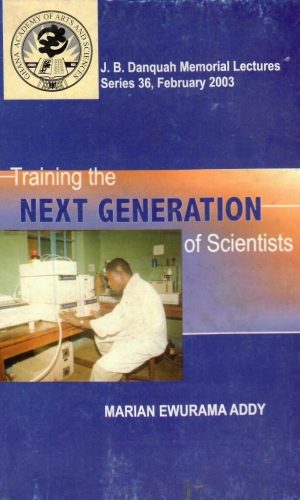
Training the Next Generation of Scientists (The J.B. Danquah Memorial Lecture, Series 36; 2003)
Lectures delivered by Professor Marian Ewurama Addy. Delivered in February 2003.
Lecture 1: Current Programmes for Scientific Manpower Development
Lecture 2: The Way Forward
Lecture 3: Hopeful Signs
₵10.00 -
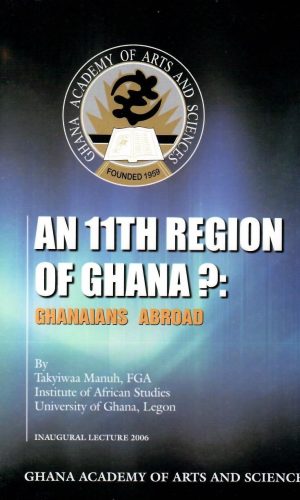
An 11th Region of Ghana? Ghanaians Abroad
Inaugural lecture by Professor Takyiwaa Manuh, University of Ghana. Delivered in 2006.
₵15.00 -
Where There is No Silence: Articulations of Resistance to Enslavement
Inaugural lecture by Professor Naana Jane S. Opoku-Agyemang, University of Cape Coast. Delivered in 2006.
₵15.00 -
Proceedings of the Ghana Academy of Arts and Sciences (Volume XIV, 1976)
Proceedings, 1976.
Contents
Address by Dr. R.K.A. Gardiner, Commissioner for Economic Planning, on the occasion of the 16th Anniversary Dinner of the Ghana Academy of Arts and Sciences
Address by the President of the Academy, Professor E.A. Boateng on the occasion of the 16th Anniversary Dinner of the Ghana Academy of Arts and Sciences held on November 28, 1975
The Two Faces of Development – Professor E.A. Boateng
The Energy Problem in Perspective – Professor D.A. Bekoe
The Black Pod Disease of Cacao – Observations on the Parasite – Professor G.C. Clark
On the Growth of Man – Professor S. Ofosu-Amaah
Physical Sources of Energy – Dr. A.N. May
Chemical Sources of Energy – Dr. W. R. Philips
Biological Sources of Energy – Professor E. Laing
Nuclear Pollution – Dr. B.W. Garbrah
Biological Pollution – Professor S. Ofosu-Amaah
The Oil Crisis and its Impact on Ghana – Dr. Kobena G. Erbynn
The Economics of Energy in Ghana – Dr. Assibi O. Abudu
The Political Aspect of Energy for Development – Mr. W.S. Parker
₵20.00 -
Proceedings of the Ghana Academy of Arts and Sciences & The J.B. Danquah Memorial Lecture, Series 2 (Volume VII, 1969)
Proceedings, 1969. This issue contains the second series of the J.B. Danquah Memorial Lectures delivered by C. A. Ackah in 1969.
Contents
Drugs and Our Society – Professor A.N. Tackie
Science and Religion – Professor J. Yanney Ewusie
Some Fundamentals in the Political Scene – C.A. Ackah (The J.B. Danquah Memorial Lecture, Series 2)
A Systems Approach to the Provision of Urban Facilities – E.D. Ehrenkrantz
Urban Planning – S.B. Amissah
Administration, Economics and Finance of Urban Planning – J.W.S. de Graft-Johnson
Housing – J. Owusu Addo
Communications – A.L. Bright-Davies
Urban Transportation – Mr. E. Lartey
Electric Power Supply – G.K. Homenoo
Problems of Urban Water Supply – C.K. Annan
Problems of Environmental Sanitation – H. Noye-Nortey
₵20.00