-
Commercial Law in Ghana: Sourcebook (Hardcover)
Commercial Law in Ghana: Sourcebook is written as a primary text for the study and practice of commercial law in Ghana. The book prioritises Ghanaian judicial decisions in the discussion of the various topics and legal concepts in commercial law. The book covers topics such as Law of Agency, Sale of Goods, Hire Purchase, Negotiable Instruments, Banking, as well as commercial litigation and arbitration. The book contains a lucid reader-friendly analysis of topics in commercial law in the light of relevant Ghanaian case law and legislation. The book will serve the needs of students of the law by providing them with legal analysis backed by Ghanaian sources. It would also serve as a practical guide to practitioners of commercial law.
₵500.00 -
Conflict of Laws in Ghana
Generations of Ghanaian law students, scholars, legal practitioners and judges have engaged with conflict of laws issues in their respective capacities. Regrettably, they have not had access to an authentic Ghanaian treatise on the discipline — a treatise foregrounded in Ghanaian case law and legislation. They have had to rely on foreign treatises (often very dated editions) mainly written by reputed English scholars.
Richard Frimpong Oppong and Kissi Agyebeng have filled this void in the scholarship on Ghanaian law with their sophisticated and skilfully executed work of scholarship: Conflict of Laws in Ghana.
This monograph is a timely publication. We live in a globalised world, a world beset with conflict of laws problems. Increases in cross-border movements of persons and the concomitant cross-border relationships they create, the growth of international commerce and foreign direct investment, ever-increasing international litigation, and international arbitration have all highlighted the importance of conflict of laws as a discipline.
Judges, legal scholars, legal practitioners, law students and, indeed, all who operate in the international legal terrain, must take notice of this comprehensive work.
The range, depth and originality of Conflict of Laws in Ghana make it a must-read for anyone confronted with a conflict of laws issue in Ghana. They will find much value in doing so.
₵335.00Conflict of Laws in Ghana
₵335.00 -
Beyond the Political Spider: Critical Issues in African Humanities (African Humanities Series)
Beyond the Political Spider: Critical Issues in African Humanities by Kwesi Yankah is the first title in the newly established African Humanities Association (AHA) publication series.
By integrating his own biography into a critique of the global politics of knowledge production, Yankah, through a collection of essays, interrogates critical issues confronting the Humanities that spawn intellectual hegemonies and muffle African voices. Using the example of Ghana, he brings under scrutiny, amongst others, endemic issues of academic freedom, gender inequities, the unequal global academic order, and linguistic imperialism in language policies in governance.
In the face of these challenges, the author deftly navigates the complex terrain of indigenous knowledge and language in the context of democratic politics, demonstrating that agency can be liberatory when emphasising indigenous knowledge, especially expressed through the idiom of local languages and symbols, including Ananse, the protean spider, folk hero in Ghana and most parts of the pan-African world.
“Fascinating snapshots from an engaged scholarly life in Africa, valuable as an archival resource for the understanding of this period of higher education in Africa.” – John Higgins, Arderne Chair in Literature, Department of English Literary Studies, University of Cape Town
“This book is unique and gives a powerful rendition of the state of the Humanities in Africa (with Ghana as a case in point). It grapples with some of the pertinent issues dogging the Humanities in Africa. It comments on the Humanities scholarship in Africa, and subtly throws a challenge for future scholarship. It draws on African traditions, communal heritage, and governance in discussing the role and place of the Humanities in Africa. It also brings into the analysis the ever-changing imperatives and modernity in re-configuring African Humanities.” – Mark Benge Okot, Head of Department, Literature, Makerere University, Uganda
“Beyond the Political Spider’ effectively draws, in a unique fashion, from literature, history, linguistics and other cognate disciplines in the African Humanities.” – Sati Umaru Fwatshak, Department of History, University of Jos, Nigeria
₵340.00 -
Notes on Amma Darko’s Faceless
This book, Notes on Faceless, is intended as a study guide for students of Amma Darko’s novel, Faceless. Readers of Faceless go back again and again to this novel because it makes them feel and think about many issues in the book that relate to what happens around them. A good work of fiction allows us to imaginatively participate in what it means to be part of human society. Fiction “holds up a mirror” to us about life. It is therefore important to be able to understand and explain, as well as becomes more alert to how literature works. This book aims to help you do so, focusing on Faceless.
Notes on Faceless discusses what Darko does in Faceless and how she does it: the plot of the story, its setting, characterization, theme and style. Like every other field of study, literature has a special vocabulary that is used by all good students of the subject. Therefore, while discussing the essential elements in Faceless (i.e. plot, setting, etc.), this book also introduces you to some of the important literary terms or technical vocabulary used in reading literature. The goal is to make you familiar with the right language for talking and writing about a work of literature and to teach you how to use this language in your own reading and writing.
This book takes you further into your study of literature by guiding you to use suitable vocabulary to actually talk and write about a work of literature. After walking you through a discussion of each element, Notes on Faceless gives you practice in writing about Faceless in particular and literature in general.
₵35.00 -
Philosophy, Culture and Vision: African Perspectives
Believing that the intellectual enterprise called philosophy is essentially a part of the cultural as well as historical experience of a people, that the concepts and problems that occupy the attention of philosophers placed in different cultural spaces or historical times generally derive directly from those spaces and times, and that philosophy, in turn, has been most relevant to the development of human cultures, the Ghanaian philosopher Kwame Gyekye gives reflective attention in this book to some of the concepts and problems that in his view feature most prominently in the contemporary African cultural, social, political, and moral experience. Such concepts and problems include the following: political legitimacy, development, culture and the pursuit of science and technology, political corruption, democracy, representation and the politics of inclusion, the status of cultural values in national orientation, understanding globalization, and others. It is these topics that are covered in the essays collected in this book.
The unrelenting pursuit of the speculative activity by the philosopher in most cases eventuates in normative proposals; these normative proposals often embody a vision-a vision of an ideal human society in terms of its values, politics, and culture. Vision, understood here, has human-not supernatural or divine-origination and involvement and requires action by human beings in order for it to come into reality. A vision may derive from sustained critical evaluation of a culture or some elements of it. Gyekye attempts an articulation of the visions of the essays contained in the book.
Even though philosophical ideas and concerns are originally inspired by and worked out in a cultural milieu, it does not necessarily follow, Gyekye strongly believes, that the relevance of those ideas and insights is to be tetheed to the cultures that produced them. For, more often than not, the relevance of those ideas, or at least some of them, transcends the confines of their own times and cultures and can be appreciated by other societies, or cultures, or generational epochs. This trans-cultural or trans-epochal or meta-contextual appeal or attraction of philosophical ideas and insights spawned by a particular culture or cluster of cultures or in specific historical times is to be put down to our common human nature-including our basic human desires and aspirations. Thus, most of the essays published here should be of interest to the global community-i.e., to cultures and societies beyond the African.
₵55.00 -
Reflections on the Supreme Court of Ghana (Hardcover)
The book is intended to be a contribution to comparative knowledge on what a final and constitutional court’s role and significance are to governance in a developing country.
It provides a recently retired judge’s insights into the substantive work and function of the Supreme Court in Ghanaian society and Ghana’s legal and political system.
The book throws light on the role played by the Supreme Court in the development of Ghanaian law and the laying of the foundation for Ghana’s constitutional democracy. The establishment of a constitutional democracy in Ghana has been an important factor in the nation’s development and the Supreme Court has had an important role to play in this process. It will also be invaluable to both academic and practising lawyers, as well as at non-lawyers interested in the function and operations of the Supreme Court.
The study of the Supreme Courts of emerging democracies should be given some emphasis in comparative law. It is hoped that the material contained in this book will contribute to the facilitation of such emphasis.
₵450.00 -
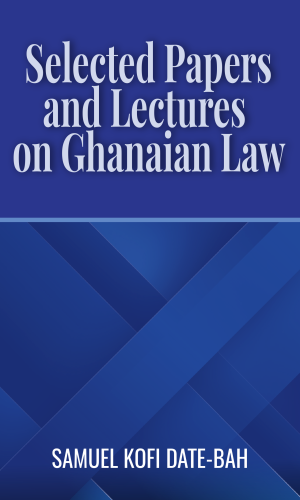
Selected Papers and Lectures on Ghanaian Law (Hardcover)
This book is a compendium containing chapters based on various papers and lectures on Ghanaian law delivered by the author. Its contents deal with a wide range of topics expected to be of interest, not only to Ghanaian lawyers, but also to lawyers in general and other persons interested in the legal process in developing countries.
The topics include the legal system and legal education in Ghana, the Judiciary, human rights and good governance, and business law.
The variety of topics treated means that the book can be regarded almost as a mini Reader on Ghanaian law.
₵200.00 -
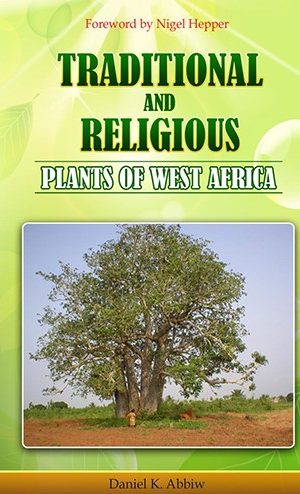
Traditional And Religious Plants in West Africa
The book is a comprehensive coverage of the Traditional and Religious Plants of West Africa. Readers will be fascinated by the information captured in this masterpiece, authored by an academic gem who is well-known in the botany field.
₵75.00 -
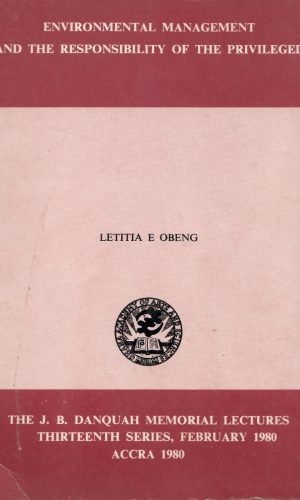
Environmental Management and the Responsibility of the Privileged (The J.B Danquah Memorial Lectures, Series 13; 1980)
This centers on the J.B Danquah Memorial Lectures Thirteenth series, February 1980 in Accra.
₵15.00 -

Waning Strength of Government: Essays on Nigerian Governance
In Waning Strength of Government, Obaze draws on twenty-three of his various speeches, policy briefs, lectures and op-eds, to render exploratory essays that dissect some common patterns and trajectories that point anthetically to factors and conducts, which ought to constitute the strength of government, but don’t. In so doing, he unmasks the prevailing weaknesses and waning strength of government – the attendant consequences, and their prevalence and implications for Nigeria.
Such developments, with the attendant reversals, some nondescript and some dramatic, but replete with absence of resilience, leads the author to assert that democracy, “once characterized as probably the greatest expansion of freedom,” has come under assault from within its ranks, as shifts in geopolitics combine with ascendancy of non-state actors to undercut democracy. Cognizant of the suggestion that the democratic system as conceptualized, has not just worked as expected, but is rather dysfunctional, the author asserts that nowhere is this consideration more evident and concrete than in Africa, Nigeria included.
Waning Strength of Government piggybacks on the assertion that Nigeria’s “democracy is in reverse gear” and “the story is that of regrets and missteps.” Obaze employs an inquiry and excursion model using the flipside of McGeorge Bundy’s 1968 seminal book, The Strength of Government, to analyze leadership, political and governance challenges that continue to dog Nigeria’s nascent democracy. The essays in this volume, which are clustered into four groupings; democratic imperatives; domestic development challenges; foreign policy dimensions and leadership and governance, explore some Strength, Weaknesses, Opportunities and Threats (SWOT), as well as general challenges and uncertain aspects of Nigeria’s affected democracy.
In this very important work on Nigerian contemporary politics, leadership and dilemmas confronting the nation, the point is made severally, and vehemently too, that the strength of government is not about military capacity or use of force; but about the upholding the rule of law, consolidating democratic institutions and entrenching the social contract between the government and the governed.
₵75.00 -

Times, Thoughts and Ideas: Selected papers of Professor Anya O. Anya (Volume 1)
Selected papers of Professor Anya O. Anya.
Compiled and Edited by Ndubuisi Ofondu, Ireke A Kalu Onuma, Ogbonna Oleka.
₵75.00 -

Times, Thoughts and Ideas: Selected papers of Professor Anya O. Anya (Volume 2)
Selected papers of Professor Anya O. Anya.
Compiled and Edited by Ndubuisi Ofondu, Ireke A Kalu Onuma, Ogbonna Oleka.
₵75.00