-

Political Advocacy (38)
-
Elections & Political Process (498)
-
Labor & Industrial Relations (116)
-
Media & Internet (8)
-
Terrorism (1)
-
Globalization (12)
-
History & Theory of Politics (16)
-
Ideologies & Doctrines (506)
-
Intelligence & Espionage (1)
-
International & World Politics (574)
-
Southern African Liberation Struggles 1960-1994 (Contemporaneous Documents, 9 Volumes)
These 9 volumes are the most comprehensive historical record of the liberation struggles in southern Africa. Comprising 2.4 million words in 5,394 pages, they record interviews with liberation fighters and supporters in the Frontline states and the extraordinary sacrifices they made so that Africa could at last be free. With the fall of the South African apartheid regime, the Southern African Development Community (SADC) identified the need to record the experiences of the liberation struggles in Southern Africa, from 1960 until that final liberation in 1994. To that end, SADC launched the Hashim Mbita Project – named after the last Executive Secretary of the OAU Liberation Committee.
The research covered liberation movements in the countries which engaged in liberation wars, the Frontline states and Extension countries; and the Research Project team comprised members from the SADC mainland states of Angola, Mozambique, Namibia, South Africa, Zimbabwe, Botswana, Tanzania, Zambia, Malawi, Lesotho and Swaziland. The support received from other regions is documented: Anglophone West Africa, Francophone Africa, North Africa, East Asia, Canada and the United States, Cuba and the Caribbean, the German Democratic Republic (GDR), Nordic Countries, Western Europe, the Soviet Union, Non-Aligned Movement: India, Yugoslavia, Indonesia, Sri lanka; Organisation of African Unity and United Nations.
₵3,000.00 -
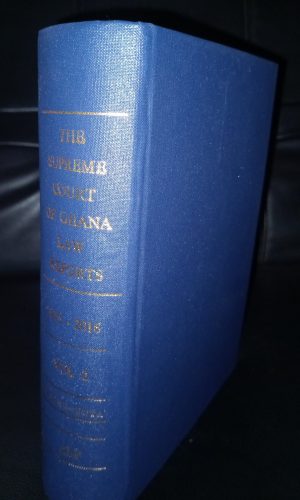
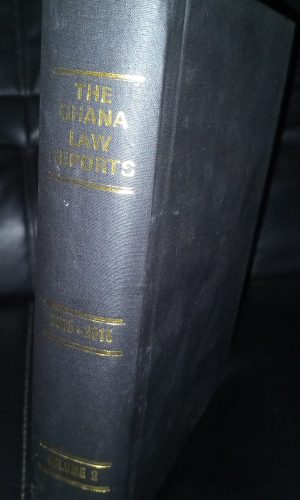
The Supreme Court of Ghana Law Reports: 2015-2016 (Volume 2)
The Supreme Court of Ghana Law Reports: 2015-2016 (Volume 2)
₵1,300.00 -
Kwahu State Book: Asaase Aban (Hardcover)
Information captured in the Kwahu State Book entails the history of Kwahu paramountcy including the five divisions of the Kwahu Traditional Area namely Adonten, Nifa, Benkum, Kyidom and the Gyase division; with histories of royal families, towns and villages under the divisions mentioned are well captured. Towns captured include Abene, Abetifi, Obo, Aduamoa, Pepease, Atibie, Bokuruwa, Nkwatia, Obomeng, Bepong, Asakraka, Kwahu Tafo, Pitiko, Akwasiho, Mpraeso, Twenedurase, Kotoso, Jejeti, Oframase, Awenare, Nkorkoor (Nkawkaw), Nteso, Tease, Kwahu Praso, just to mention few. The book also presents histories of the Zongo Community of Kwahu, the Okwawu Football Club, churches, schools and profiles of the prominent personalities (the Kwahu Golden members) of Kwahu.
The Kwahu State Book has fourteen (14) sections with each segmenting several topics and sub-topics about the history and cultural practices of the Kwahu Traditional Area. Other information in the book include chronology of chiefs and genealogy (family tree) of all the royal families. All of these have been codified into a single voluminous book of over 2,800 pages. It is the first of its kind in Ghana and sub-Saharan Africa.
All of these have been codified into a single voluminous book of over 2,800 pages. It is the first of its kind in Ghana and sub-Saharan Africa.
₵1,300.00 -
Modern Principles of Company Law in Ghana
This book is a reference book that comprehensively covers the relevant top of company law in Ghana. With the passage of the new Companies Act, 2009 (Act 992), there is a need to have a book that comprehensively explains the principles of company law. This book covers many distinct parts of company law.
The first part deals with an introduction to Company Law and companies Even though the book is on company law, the second chapter talks about other entities through which business can be undertaken or through which objects can be pursued. These entities include Sole Proprietorship, Partnership, Building Societies, Cooperative Societies, Incorporated Trust, Statutory Corporation and Non-Governmental Organisation under the proposed Non-Governmental Organisation Bill, 2018 and 2022. Chapter 3 also comes under the first part, which is an introduction to a company, requirements for the formation of a company and the types of companies that can be incorporated and registered in Ghana. Chapters 4 and 5 deal with the constitution of a company, which under the repealed Act 179 is the regulations of a company, and the role of the promoter respectively.
The second part deals with company law concepts, most of which were developed under common law and are now given statutory backing. It covers principles on pre-incorporation contract, ultra vires and capacity of a company, corporate veil and the presumption of regularity.
The third part covers governance issues, including membership, general meetings, directors, Company Secretary and auditors.
This is followed by the fourth part, which deals with raising capital for companies, including principles relating to shares and debentures, restructuring or reorganisation, and rules relating to public companies.
The last part deals with remedies available for corporate maladministration and liquidations. A new introduction in Ghana, the concept of administration of financial distress companies under the Corporate Insolvency and Restructuring Act, 2020 (Act 1015) and its amendment are also dealt with. The last chapter provides an overview of the requirements for a company to keep books of accounts and prepare financial statements.
₵1,200.00 -
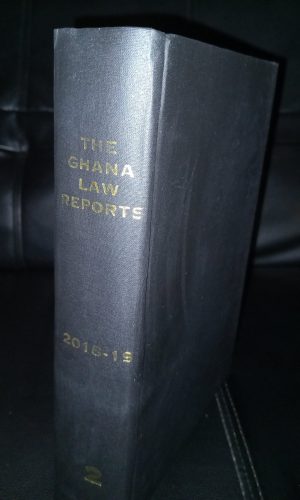
The Ghana Law Reports 2018-2019 (Volume 2)
The Ghana Law Reports 2018-2019 (Volume 2)
₵900.00 -
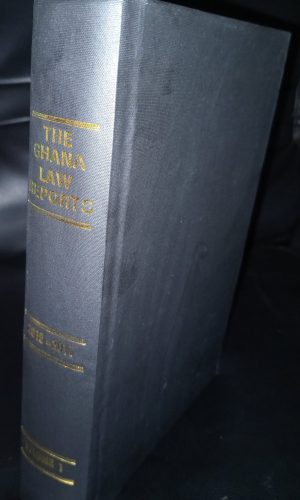
The Ghana Law Reports 2018-2019 (Volume 1)
The Ghana Law Reports 2016-2017 (Volume 1)
₵850.00 -
The Mkapa Years: Collected Speeches (3-Volume Box Set, Hardcover)
This collection of speeches, in three volumes, by the third President of the United Republic of Tanzania, Benjamin William Mkapa (1995–2005), will serve primarily as reference documents to the vision of what he attempted to achieve in his ten years of leadership. His tenure as a leader came at a time when Tanzania’s economy was in dire condition. The legacy of the command economy, which had been in place for much of the 1970s and 1980s, was still felt. There was resistance to change to adopt a market economy, evident in the political tensions and debates about privatisation, an approach following Structural Adjustment Programmes, imposed by the International Monetary Fund and the World Bank, that had led to stagnation of the economy, high inflation, deteriorating health, education, communication, and transport sector services, as well as general gloom in the country especially among the poor. The bold steps he took during the first half of his administration did not immediately endear him to the public. However, in the ensuing years, slowly but steadily, positive results were achieved, and the social cost of change that the people had endured was appreciated. Relations with development partners and the multilateral agencies that before he took office had sunk to the lowest ebb were restored, and Tanzania, which was no longer unfit to borrow, received the largest debt relief ever and henceforth. Tanzania was on its way to new growth potentials and a vibrant private sector-led economy.
These collected speeches tell this story and tell it well, in great prose laced with wit and quotations from world political and literary sources, which is an evidence of his erudition as a literature student and journalist.
₵850.00 -
The Ghana Law Reports 2016-2017 (Volume 1)
The Ghana Law Reports 2016-2017 (Volume 1)
₵690.00 -
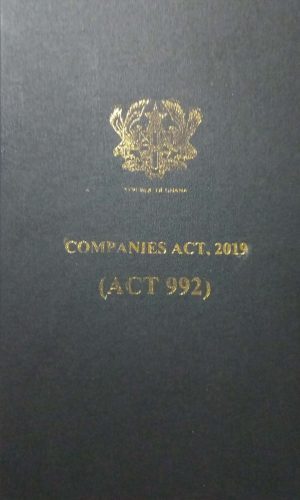
Companies Act, 2019 (Act 992, Hardcover)
Companies Act, 2019 (Act 992) (Hardcover)
₵640.00 -
Customs (Amendment) Act, 2015 (Act 905)
Customs (Amendment) Act 2015 (Act 905)
₵559.00 -
The Putin Mystique: Inside Russia’s Power Cult (Pre-Order)
Getting to grips with Russia’s 21st century Tsar.
Vladimir V. Putin has confounded world leaders and defied their assumptions as they tried to figure him out, only to misjudge him time and again. The Putin Mystique takes the reader on a journey through the Russia of Vladimir Putin, named by Forbes magazine in 2013 as the most powerful man in the world. It is a neo-feudal world where iPads, WTO membership, and Brioni business suits conceal a power structure straight out of the Middle Ages, where the Sovereign is perceived as both divine and demonic, where a man’s riches are determined by his proximity to the Kremlin, and where large swathes of the populace live in precarious complacency interrupted by bouts of revolt.
Where does that kind of power come from? The answer lies not in the leader, but in the people: from the impoverished worker who appeals directly to Putin for aid, to the businessmen, security officers and officials in Putin’s often dysfunctional government who look to their leader for instruction and protection.
In her writing career, Anna Arutunyan has travelled throughout Russia to report on modern Russian politics. She has interviewed oligarchs and policemen, bishops and politicians, and many ordinary Russians. Her book is a vivid and revealing exploration of the way in which myth, power, and even religion interact to produce the love-hate relationship between the Russian people and Vladimir Putin.
₵536.00 -
The Ghana Law Reports 2013-2015 (Volume 2)
The Ghana Law Reports 2013-2015 (Volume 2)
₵530.00