-
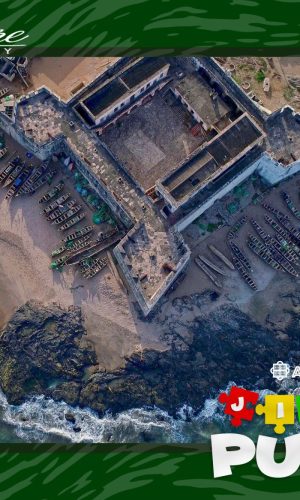
Abusua Pa Jigsaw Puzzle: Elmina Castle (140/216 Puzzle Pieces) – Pre-Order
Elmina Castle, also known as St. George’s Castle, is a historic fortress located in the town of Elmina in the Central Region of Ghana. It was built by the Portuguese in 1482 and is recognized as the oldest European-built structure in sub-Saharan Africa.
The castle was originally constructed as a trading post for the Portuguese to establish and maintain their presence in the region. It served as a major hub for the transatlantic slave trade, with thousands of enslaved Africans passing through its doors on their way to the Americas.
Elmina Castle played a significant role in the colonial history of Ghana. It changed hands several times, with the Dutch capturing it from the Portuguese in 1637, and later the British taking control in 1872.
Today, Elmina Castle is a UNESCO World Heritage site and a powerful symbol of the transatlantic slave trade. It attracts visitors from around the world who come to explore its dungeons, learn about its history, and reflect on the profound impact of slavery on Africa and the African diaspora. Guided tours are available to provide insights into the castle’s dark past and the harsh realities faced by those who were held captive within its walls.
₵450.00 -
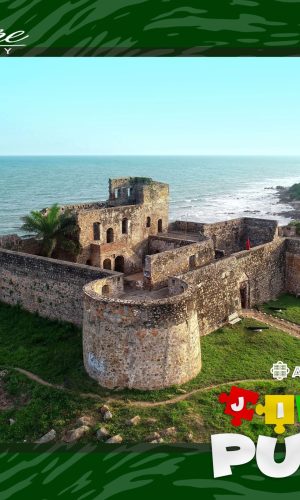
Abusua Pa Jigsaw Puzzle: Fort William (216 Puzzle Pieces) – Pre-Order
Fort William, originally known as Fort Anomabo, is a historic fortress located in Central Region of Ghana. During the 19th century, under the command of Brodie Cruickshank, the fortress was renamed Fort William in honour of King Charles II.
Constructed primariily using local resources, this remarkable stronghold earned the reputation of being one of the most splendidly designed and sturdily built fortresses along the coast.
Throughout its existence, it served diverse purposes. Initially functioning as a rest house and a post office, Fort William underwent a transformation and was repurposed as a state prison, a role it fulfilled until 2001. Today, the fort has undergone another metamorphosis and currently serves as a community library, enriching the lives of the people of Anomabu. This conversation not only preserves its historical significance but also stands a a beacon of knowledge and learning within the local community.
₵450.00 -
Abusua Pa Jigsaw Puzzle: Fort Amsterdam (216 Puzzle Pieces) – Pre-Order
Fort Amsterdam is a historic fort located in the town of Abandze in the Central Region of Ghana. It was built by the Dutch in 1638 as a trading post for gold and ivory, and later served as a slave trading station.
The fort was strategically located on a hill overlooking the Atlantic Ocean, allowing the Dutch to have a clear view of incoming ships. It was also built with stone walls and cannons to protect against attacks from rival European powers and indigenous groups.
During its occupation by the Dutch, Fort Amsterdam was an important center for the transatlantic slave trade, with thousands of Africans passing through its gates before being shipped off to the Americas.
Today, the fort is a popular tourist attraction and a reminder of Ghana’s colonial past. Visitors can tour the grounds and learn about the fort’s history through exhibits and guided tours.
₵450.00 -
Abusua Pa Jigsaw Puzzle: Chief Dancing (140/216 Puzzle Pieces) – Pre-Order
A Chief’s Dance in Ghana holds great cultural significance as a symbol of the chief’s authority, heritage and community unity. It preserves Ghanaian traditions and passes down ancestral knowledge. The dance has ritual and spiritual elements and honours ancestors and historical lineage.
It showcases cultural identity and attracts tourists, promoting cultural pride and understanding. The Chief’s Dance plays a vital role in Ghanaian society, connecting the past with the present and ensuring the continuity of cultural heritage.
₵450.00 -
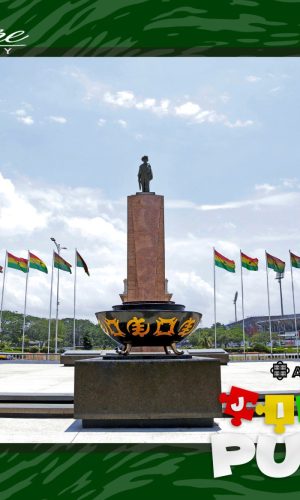
Abusua Pa Jigsaw Puzzle: The Black Star Square (216 Puzzle Pieces) – Pre-Order
Independence Square, also known as Black Star Square, is a landmark in Accra, Ghana, with historical and cultural significance. It serves as the venue for Ghana’s Independence Day celebrations and features symbolic elements like the Independence Arch and the Independence Square Monument. The square is one of the world’s largest and can accommodate large gatherings. It has surrounding landmarks and is open to the public for recreational activities. Independence Square holds historical significance as the site where Ghana proclaimed its independence from British colonial rule in 1957. It stands as a symbol of national pride and hosts events that commemorate Ghana’s freedom.
The soldier facing the Independence Arch in Ghana symbolizes the country’s struggle for independence and its emergence as the first sub-Saharan African nation to gain freedom from British colonial rule. The soldier represents the Ghanaian military’s dedication to protecting the nation’s sovereignty and symbolizes the courage and sacrifice of the people in their fight for self-rule. It serves as a reminder of Ghana’s commitment to preserve its independence, uphold values of freedom and democracy, and promote national unity. Overall, the soldier facing the Independence Arch represents the historical significance of Ghana’s independence, the contributions of the military, and the ongoing commitment to safeguard the nation’s sovereignty.
₵450.00 -

The Chronicles of the Black Star Jersey: A Historical Compilation of Football Kits Worn by the Ghana National Teams (1951-2022) – Pre-Order
Available from 25th September, 2023
Football has gained considerable grounds in the sporting culture of Ghana. Along with it came other auxiliary aspects of the game, as the beautiful sport assumed global status. Ghana’s introduction to the game in its formal aspects commenced with exposure by foreigners in thier trade missions to the shore of the Gold Coast. Interactions with these foreigners led to several eye-opening aspects of the game from training and preparations, strategies and tactics, as well as apparel used for matches.
This book catalogues the journey of the jerseys used by Ghana’s National Teams together with some key historical facts and tales about some legendary names to have ever donned the famous Ghana kit. From the colonial era, this heralded an active administration of the colony by the British, through to the glorious winning decades of the sixties and seventies, the ‘skin’ of Ghanaian players on the pitch, with its designs, meanings, and significance captured in simple but memorable fashion.
₵400.00 -
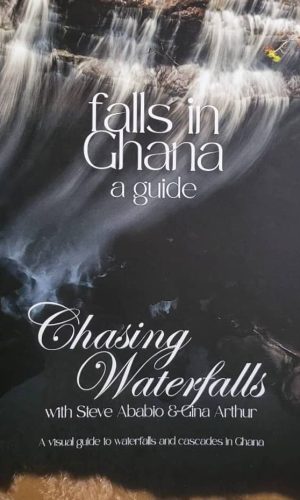
Falls in Ghana: Unified Guide Book (Chasing Waterfalls with Steve Ababio & Gina Arthur)
This is a guide based on our experience – designed to help you get out and go have your waterfall adventure. This book details our experiences on and off the road, encounters, processes, ease of access and what sight awaits you.
This guide will help reduce the unknown variables and provide some structure in terms of what to expect and what approaches to take on your journey as you interact with different communities.
The stories and experiences shares should also help boost your confidence and encourage you to make a plan and embark on a waterfall chase of your own!
₵400.00 -
World Globe
This Globe is perfect for teaching geography to new learners. It has a sturdy base and a design which acts as a visual reference during geography lessons.
The globe is perfect for use at home or school.
You can use it to teach new learners about different countries, continents and more.
It has a durable plastic construction with a sturdy base.
The globe has a natural colour scheme with blue oceans and coloured land.
₵335.00World Globe
₵335.00 -
More Than My Scars: The Power of Perseverance, Unrelenting Faith, and Deciding What Defines You
The first thing you will notice when you meet Kechi Okwuchi is her scars. One of just two survivors of a devastating plane crash that killed more than 100 people, 16-year-old Kechi was left with third-degree burns over 65 percent of her body. More Than My Scars is her incredible story. A story of not just surviving impossible odds but thriving in a world that is too often caught up with how we look on the outside rather than seeing that our true value is within.
Now in her early 30s, Kechi has spent the last 16 years refusing to be defined by her trauma. Follow her as she decides for herself what role her scars will play in her life before society decides for her. Her strong sense of identity, rooted in seeing herself the way God sees her, has allowed her to live authentically in a world that constantly seeks to define us by its ever-changing (and ever-shallow) standards. Kechi’s story will inspire you to love and accept yourself as you are and confidently present your true self to the world.
₵330.00 -

Nana Otuo Siriboe II, 1971-2021: Fifty Years of Distinguished Service to Juaben, Asanteman and Ghana
Foreword by President Nana Akufo-Addo
Nana Otuo Siriboe II was enstooled as Juabenhene – Paramount Chief of the Juaben Traditional Area of Asante − on August 31 1971, at the age of 26. An electrical engineer by training, he decided to leave the employ of the Electricity Corporation of Ghana and make the development of his State a priority.
Fifty years on, from the days of Dr. K.A. Busia, Acheampong, Akuffo, Rawlings, Limann, Rawlings, Kufuor, Mills, Mahama to Akufo-Addo in 2021, he has transformed Juaben into a modern town. He uses every opportunity that he has to advance the cause of Juaben. Every development agency that has ever dealt with Nana Otuo Siriboe has been persuaded to leave a mark in Juaben. Under his supervision and guidance, Juaben has benefitted from electricity, potable water, a market, hospital, police station, some bungalows for the police, a circuit court, an asphalted road network, street lighting and other modern amenities.
He has also changed the economic circumstances of his people by not only establishing a rural bank, but also making farming attractive through his own oil palm farming activities and his setting up of Juaben Oil Mills, the largest indigenously-owned palm oil processing facility in Ghana, with over 400 employees. An interesting feature of the processing plant is the conversion of its waste materials into electricity to power the factory’s plant and equipment, the Juaben Hospital and the town’s water pumping station.
In spite of this unparalleled service to his people, Nana Otuo Siriboe has stretched his influence way beyond Juaben. A trusted lieutenant of both Otumfuo Opoku Ware II of blessed memory and the reigning Asantehene, Otumfuo Osei Tutu II, today Nana Otuo Siriboe II is a well-known and respected statesman across Ghana. He has had the privilege of serving in many sectors of public life in Ghana. In 1979, he was a Member of the Constituent Assembly that drafted the 1979 Constitution. Nana Otuo Siriboe II has also served on several Boards and Councils such as the Boards of the Lands’ Commission, GBC, The Trade Fair Authority and The Komfo Anokye Hospital and on the KNUST University and the Prisons Service Councils.
In 1992, he was thrust further into the limelight when, as a nominee of the Ashanti Regional House of Chiefs, he became a Member of the Consultative Assembly, serving as the Chairman of the Business Committee, that spearheaded the drafting of the 1992 Constitution. He was a Member of the Council of State between 2001 until 2008 under President J.A. Kufuor. In 2017, he was appointed a Member of the Council of State by President Nana Addo Dankwa Akufo-Addo and was unanimously elected as Chairman of the Council of State becoming the first traditional ruler in Ghana’s history to occupy that august position. Reappointed to the Council of State in 2021 and re-elected as Chairman, he has also become the first Ghanaian in history to be a two-term chairperson of the Council of State.
This 308-page Golden Jubilee coffee table book chronicles the major milestones of Nana Otuo Siriboe II’s reign through captivating photographs, interesting newspaper clippings, and thought-provoking newspaper editorials; and has travelled through a 25-year journey to get to this point.
The History of Juaben was authored by Emeritus Professor Albert Adu Boahen of blessed memory and the Juabenhene’s biography and key achievements by Professor Robert Addo-Fening for the 25th and 40th anniversary brochures respectively. Abyna-Ansaa Adjei, on her part, documents Nana Otuo Siriboe II’s activities of the past 10 years, his views on his 50-year reign as well as the views of some Juaben citizens.
A simple read, it comes highly recommended with a goodwill message from the Asantehene, Otumfuo Osei Tutu II and a foreword by President Nana Akufo-Addo, which states at its conclusion: “I recommend, most enthusiastically, this beautiful book that chronicles these events.”
₵300.00 -
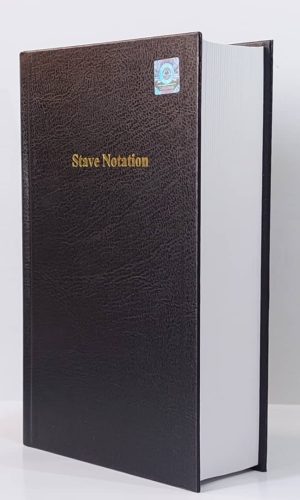
Methodist Hymn Book with Tunes – Stave Notation (Hardcover)
First published in 1933, this contains the hymns in the Methodist Hymn books accompanied by their staff notations. It also includes tunes for the Canticles, Psalms and other Bible passages included the Beatitudes. It is a useful resource for church choirs and all music lovers.
₵270.00 -
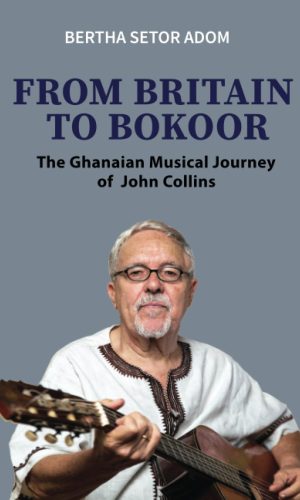
From Britain to Bokoor: The Ghanaian Musical Journey of John Collins
Highlife, a popular West African genre, is easily the soundtrack to the life journey of the nation Ghana. And if there is one personality who has contributed the most to documenting it, it is Professor John Collins, a naturalized Ghanaian of British descent and a professor of music at the University of Ghana, Legon. Collins originally accompanied his parents to Ghana in 1952, when his father was setting up the philosophy department at the University of Ghana. Returning to Britain with his mother, Collins was educated in Bristol, Manchester and London, earning a science degree. He was also playing music and then he returned to Ghana in 1969 to study archaeology and sociology at the University of Ghana.
Eventually he himself became an academic teaching and researching popular music. This book captures the life and music career of Collins. What makes him an enigma is his personal involvement on the road as a guitar playing member of concert party bands. His working relations with Fela, E.T. Mensah, Kofi Ghanaba, Victor Uwaifo, Prof. J. H. Kwabena Nketia and many legendary names in the music space of West Africa make him a legend in his own right. This is the story of a “white man” man who came to Africa to legitimize the place of highlife as consequential to world music
₵250.00