-
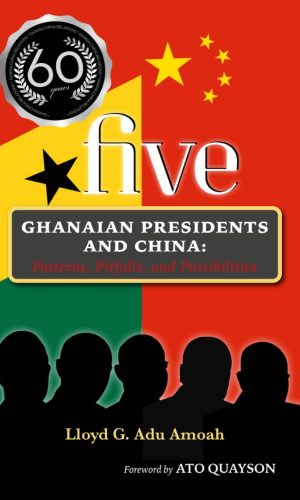
5 Ghanaian Presidents and China: Patterns, Pitfalls, and Possibilities
In Five Ghanaian Presidents and China, Lloyd Amoah tackles China’s meteoric rise to global prominence and what this means for African countries including Ghana. Focusing on Ghana’s relations with China over the last sixty years, the work discusses and interrogates how generations of Ghana’s leaders, from Kwame Nkrumah to Akufo-Addo, have approached the China question since the 1950s.Combining archival data, policy information, interviews and conversations with former Ghanaian presidents, scholars and high state officials, with the sounds and sights from his long years of travel through China and intimate observation of Ghanaian policy formation processes, Amoah, finds that ultimately Ghana’s engagement with China is a matter of strategy. In this work the case is made that descriptions of China’s engagement with Africa as “neo-colonial” are both alarmist and simplistic. Five Ghanaian Presidents offers a far more nuanced account and shines some light on how African and other countries in the Global South can exploit China’s tectonic reshaping of global trade, technology, diplomacy, finance, politics, business and economics.
₵200.00 -
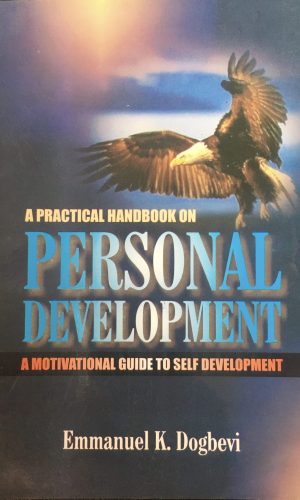
A Practical Handbook on Personal Development
“…one must first look into oneself before looking out for achievements. Thus self-knowledge as a foundation to personal development is crucial to any type of personal attainment. This is what this book is about!
It leads you step by step to discover your own potential and how you can skilfully release this potential to achieve a life that wins.” – The Late Rev. Prof. Elom Dovlo (Former Head of Department for the Study of Religions – University of Ghana, Legon) – Foreword
₵15.00 -
Who Owns the Land and Who Rules the Land?
Ghana is undergoing her fourth experiment in Constitutional Rule − the 4th Republic. She was the first Black African country south of the Sahara to gain her political independence in 1957 but economic independence has eluded her till now. Her development is at a snail-pace at best.
According to the author, there are certain fundamental bottlenecks in the country’s governance system which make it difficult for her to realize her economic potential. The author compares Ghana’s governance system to Singapore which gained political independence around the same time as Ghana but has successfully transformed from Third World to First World economic status in 30 years and asks why the difference. The author calls for a national debate on the country’s governance system that will lead to a total review of the 1992 Constitution. The following are some of the key issues he calls the nation’s attention to:
- A Feudal Land Tenure System whereby more than 90% of the land mass of Ghana is vested in the Chieftaincy institution as Stool Lands and the remaining 10% vested in the President on behalf of the people of Ghana as Public Lands. A system which greatly impedes development and benefits only a privileged few and yet there are no Land Reforms
- The Legacy of the Colonial Indirect Rule leading to a “bifurcated state” in which traditional authority runs parallel to civilian political authority
- An Ineffective Decentralization System which excludes the traditional leaders and refuses to allow the people to elect their own District Chief Executives whom they can hold accountable
- An Adversarial Political System in which the two main political parties have indulged in violence since independence and thus refuse to reach consensus for national development
- The Short Tenure of the Executive and Legislature which does not promote long term planning and execution for meaningful development
- An expensive electoral system which engenders corruption and prevents well-meaning and qualified candidates from offering themselves for governance
- The Lack of a National Agenda for development and dependence on party manifestoes thus ignoring the Directive Principles of State Policy. Development is thus not progressive but disjointed and depends on which party is in power
- A Council of State which is merely advisory and has no power to serve as a check on the Executive
- A National Mindset of Dependency Syndrome and Entitlement Mentality which has resulted in lack of effective mobilization of the populace by the political and traditional leadership. A national psyche that does not promote self-reliance and the can-do spirit
- A Governance System which tries to copy Westminster and American systems instead of a home-grown system which suits our situation and promotes development
- An Educational System that fails to build problem-solving abilities and patriotism into the youth and fails to make them proud of being Africans
- A Very Strong Religious Atmosphere which feeds on superstition and does not enable the teeming members to transform their mindset and focus on teachings which promote hard work, wealth creation and prosperity
₵180.00 -
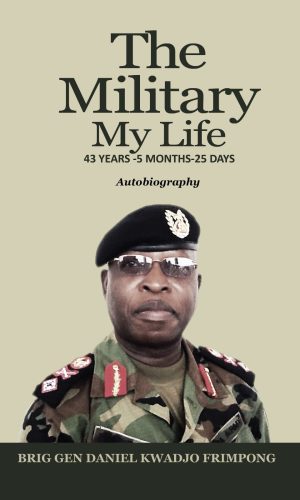
The Military, My Life: 43 Years – 5 Months – 25 Days: Autobiography
The Military, My Life: 43 Years – 5 Months – 25 Days: Autobiography is General Frimpong’s fifth book.
Starting from his primary school days across Ghana, his secondary education and enlistment into the Ghana Armed Forces in 1970, he discusses his long career in the military, community service, diplomatic life, incursions into academia, retirement in 2014 after over forty-three years’ service, and life after retirement.
He also discusses his sojourns in Nigeria, Kenya, Uganda, Canada and the USA.
Maj Don-Chebe states in the Foreword:
“For the officers who have schooled peacefully and smoothly in the Ghana Armed Forces, spare a thought for officers like Brig Gen Dan Frimpong, who blazed the trail and suffered all kinds of indignities to his person and unholy twists in his career path. His numerous runs-in with the Military High Command is a subject that should inform commanders at various levels that, a knowledge-based and future-focused Armed Forces needs a certain kind of officer hungry for knowledge and determined to compete with the best inside and outside.
“The autobiography of Brig Gen Dan Frimpong should give hope and confidence to young persons, inside and outside the Military to continue to pursue their dreams and aspirations. Any setback can only be temporary; persistence, perseverance, determination and grit should drive you forward.”
₵200.00 -
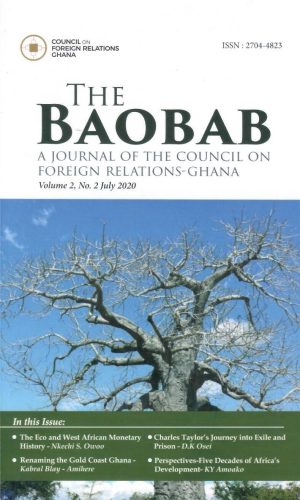
The Baobab: A Journal of the Council on Foreign Relations-Ghana (Vol 2, No 2 – July 2020)
IN THIS ISSUE
From the Managing Editor
Editorial
Members in the News
Covid-19: 10 Policy Priorities for Africa’s Recovery, Growth and Transformation
The Eco and West African Monetary History
Nkechi S. Owoo
Special Review Essays and Features on: Ghana, Liberia and Africa in Historical Transitions
Renaming the Gold Coast Ghana
Kabral Blay-Amihere
Still Contested After All these Years
David Owusu-Ansah
Ghana: The Secession Movement and the Trans-Volta Togoland
Boni Yao Gebe
Charles Taylor’s Journey into Exile and Prison
DK Osei
Perspectives-Five Decades of Africa’s Development
KY Amoako
About the Contributors
Editorial Policy and Guidelines
History of the CFR-Ghana
₵50.00 -
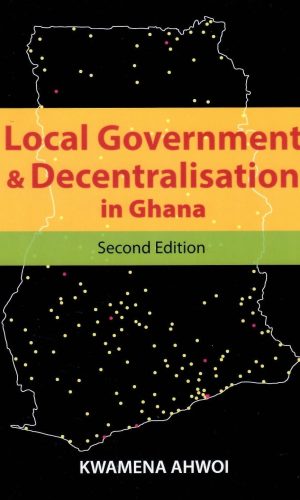
Local Government and Decentralisation in Ghana
Developments since the publication of the First Edition of this book in 2010 have compelled the revision and publication of this Second Edition.
In 2011, the Fifth Government of the Fourth Republic launched a new ‘National Decentralisation Policy Framework’ (NDPF 1) and an accompanying National Decentralisation Action Plan’ (NDAP 1). The Local Government Service was operationalised in the same year, resulting in the migration of over 30,000 civil servants from the Civil Service to the Local Government Service.
Prior to these, the Local Government Departments of District Assemblies) (Commencement) Instrument, 2009, L.1. 1961, had been enacted, allowing for the conversion of the de concentrated Departments at the district level into devolved Departments of the District Assemblies. The Local Government (Urban, Zonal and Town Councils and Unit Committees) (Establishment) Instrument, L.1. 1967, was enacted in 2010. The long-awaited Composite Budget was introduced in 2012.
With the expiry of the NDPF 1/NDAP I in 2014, a new NDPF 11/NDAP 11 was launched in 2015 for the period 2015-2019.
A new Local Government (Sub-Metropolitan District Councils of Metropolitan Assemblies (SMDCs)) (Establishment, Composition and Functions) Instrument, 2015. 11. 2223, was enacted to provide for uniform composition and functions for the SMDCs in all the six Metropolitan Assemblies.
A National Development Planning (System) Regulations, 2016, enacted to support the National Development Planning and Act, 1994, 148. A Land Use and Spatial Planning Act, 2016, Act 925, was passed to establish a Land Use and Spatial Planning Authority and to devolve the Department of Country Planning to the MMDAs.
The disparate laws on local government were consolidated into one Local Governance Act, 2016, Act 936. A new Sports Act 2016, Act 934 and a new decentralised National Youth Authority Act 939 were also enacted.
It is these reforms that the Second Edition of the book has sought to capture, in addition to some elaborations on some of the theoretical underpinnings of local government and decentralisation in Ghana. The sections of Acton Civil Society Organisations and Non-State Actors and Women in Local Governance have been improved. Some aspects of the proposals of the Constitutional Review Commission on local government and decentralisation have been used. Some textual changes have also been made.
₵95.00 -
The Baobab: A Journal of the Council on Foreign Relations-Ghana (Vol 1, No 1 – January 2020)
IN THIS ISSUE
From the President of the Council
Editorial
The Need for a Diplomatic Think Tank
Ambassador James Victor Gbeho
Council on Foreign Relations Overdue
HE Nana Addo Dankwa Akufo-Addo, President of Ghana
Kofi Annan Biography
Memories of a Good Man from Africa
Amb Patrick Hayford
Getting to Know Kofi Annan
Excerpts from A Conversation With Mary Chinery-Hesse
(Interview by Lady Ann-Essumạn)
Kofi Annan, Africa and the Responsibility to Protect
Ramesh Thakur
Ghana in United Nations Peace Operations, A Tool of its Foreign Policy
Colonel Festus Boahen Aboagye (Retired)
Peacekeeping Experiences, Creating National Bonds
Major General HK Anyidoho (Retired)
Rethinking a New Global Order
V Antwi-Danso, PhD
Partnerships for Peace in West Africa and the Sahel: Challenges and Opportunities
Dr Mohamed Ibn Chambas
About the Contributors
Editorial Policy and Guildlines
History of CFR-Ghana
₵50.00 -
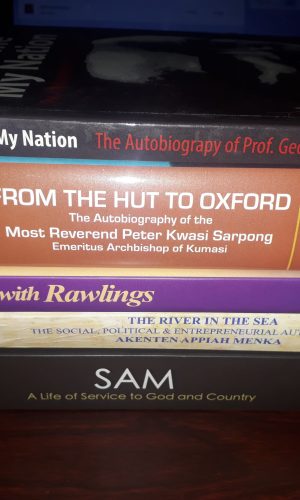
Booknook Leadership Pack: My Time My Nation, From the Hut to Oxford, Working with Rawlings, The River in the Sea, Sam (5 Exceptional Ghanaian Leaders)
Get these 5 books by five amazing Ghanaian leaders and enjoy free shipping across Ghana! 5 for 5!
*This Free shipping offer does not apply to destinations outside Ghana
Working with Rawlings
Flight Lieutenant Jerry John Rawlings burst on the Ghanaian political scene with a failed military mutiny on May 15th, 1979. On June 4th 1979, following a successful uprising staged by junior officers and other ranks of the Ghana Armed Forces, he emerged as the Chairman of the Armed Forces Revolutionary Council (AFRC) which ruled Ghana for three months and handed over to a civilian constitutional government on 24th September 1979. On 31st December 1981, he overthrew the constitutional government and formed the Provisional National Defence Council (PNDC) as the Government of Ghana. He was elected a constitutional President in 1992 and assumed office as such on 7th January 1993. He served two terms as President of the Republic of Ghana, finally leaving office on 6th January 2001.
Jerry John Rawlings is an enigma. It was a privilege working with him and being close to him. He and I went through many exciting experiences together. I have documented some of those experiences in this book. But there are many other experiences which I have not documented either because they belong to the realm of confidentiality or of privacy. What I have documented, however, is enough to give present and future leaders some ideas about governance at the highest levels; the dos and don’ts of governance; the skills required for governance and the importance of human relations as a leadership trait.
This is not a book about Jerry John Rawlings. It is not a book about Kwamena Ahwoi. It is not a book about the PNDC. It is not a book about the NDC. It is a book about Kwamena Ahwoi working with Jerry John Rawlings; our working relationship; our ups and downs and our joint commitment to building a better Ghana than the one we found it. Somewhere along the line, we drifted apart. This book is about that as well. It is my hope that Ghana’s leaders of today and our leaders of the future will learn some lessons from my account of Working with Rawlings, leaving out the negatives and accentuating the positives.
My Time My Nation: The Autobiography of Prof. George Benneh
Professor Benneh’s life story reflects the promise of the country he serves so faithfully. It captures the anticipation of the pre-independence years, the disillusionment of the forays into military rule, and the integrity of the return to civilian rule with many painful lessons learnt. Indeed, as he recalls his early years with his father on the campaign trail, he presents the mixture of excitement, superstition, and euphoria as the Gold Coast transitions into an independent country ad later the Republic of Ghana.
The author narrates his years of preparation with an impressive roll of mentors and acquaintances — Mr. Gbeho, Professor Steele, Professor Manshard. K.A. Busia, J.B. Danquah, Krobo Edusei, K.A. Gbedemah, Otumfuor Osei Tutu II, Osagyefo Dr. Kwame Nkrumah.
Through out the autobiography the reader is conscious that the astute politician is also an astute scholar—lecturer, researcher, administrator. As he brings his analytical acumen to his performance of his responsibilities as Head of Department, Pro Vice-Chancellor and, finally, Vice Chancellor, Professor Benneh demonstrates a unique ability to move seamlessly between two worlds often considered incompatible.
The autobiography provides a vivid account of an enviable range of experiences from the author’s childhood in Brong-Ahafo region, through conferences in some of the most exotic locations in the world. Yet, he always remains the family man, devoted to his covenant wife, children, grandchildren, wider family and the abiding reliance and trust in his Maker. The autobiography ends with the octogenarian’s tribute to his late father who was his first and best mentor and inspired him reach beyond the sky.
From the Hut to Oxford: The Autobiography of the Most Reverend Peter Kwasi Sarpong (Hardcover)
From the Hut to Oxford clearly shows the huge impact that Archbishop Sarpong has made during his priestly and episcopal minstry, spanning forty-nine years from 1959 to 2008. His impact has been on the Catholic Church in Ghana, education, culture and religion. The relative understanding, harmony and cooperation among the religious bodies in the country – between the Catholic and non-Catholic Christians, between followers of Islam and Christians, etc. – can be attributed in no small measure to his unflagging endeavours in ecumenism and inter-religious dialogue. Happily, his effort in this regard. Happily, his effort in this regard has been universally acknowledged. In a world racked by religious bigotry, dissension and mayhem, he deserves more than a pat on the back. — Most Rev. Matthias Kobina Nketsiah, Emeritus Archbishop of Cape Coast
The River in the Sea: The Autobiography of Akenten Appiah-Menka
The River in the Sea is a story of courage, determination, a clear sense of mission and vision on the part of a rural Ghanaian who, from humble beginnings, has risen to the highest echelon in society as a lawyer, an industrialist, a politician and statesman.It is a welcome addition to the limited literature available on the Ghanaian elite; a must read for all lawyers, politicians, academics and the populace at large.
Sam: A Life of Service to God and Country
Lawyer. Politician. Democracy and human rights activist. Prisoner of conscience. Rotarian. Father. Grandfather.
These are among the many roles Sam Okudzeto is most proud of. In his very easy-to-read memoir, SAM: A Life of Service to God and Country, he describes the journey from his village childhood, through his education in Europe, and finally to his life in the legal profession, politics and civil society of Ghana. As one who personally knew many of Ghana’s founding fathers and giants, and was active in politics during the seminal moments after independence, he offers a unique perspective of the people and events that shaped the history of Ghana and the growth of its democracy. He sheds light on the origins of many issues and shares his regrets such of the boycott by the legal profession during the drafting of the current Constitution in 1992 and the impact that boycott has had on national governance.
In this must-read memoir, he shares many lessons from a life spent on the frontlines of human endeavor. Now in his 80s, and with a life well-lived, Sam Okudzeto hopes that the current generation of Ghana will continue to build upon the foundation laid by his pioneering generation.
“Uncle Sam as some of us know him is iconic. He is larger than life in his profession, his faith and his service to humanity. His memoir deepens our respect for his intellect and joie de vivre and provide steps for us to emulate his rich and blessed life.” – Rev. Dr. Joyce Aryee, Executive Director, Salt & Light Ministries, Management and Communications Consultant
₵600.00 -
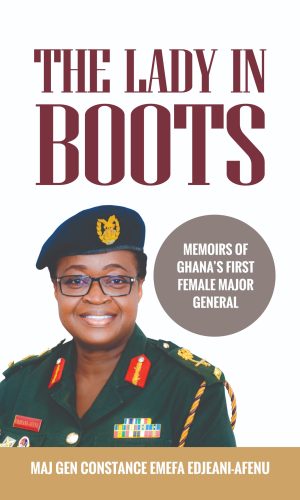
The Lady in Boots: Memoirs of Ghana’s First Female Major General
Available from 11th September, 2023
The book is Major General Constance Edjeani-Afenu’s remarkable memoir. It chronicles her 43-year extraordinary journey in the Ghana Armed Forces.
She was the first female Commanding Officer, and the first female Major General. Her story is a testimony to dedication, leadership, and resilience.₵100.00 -
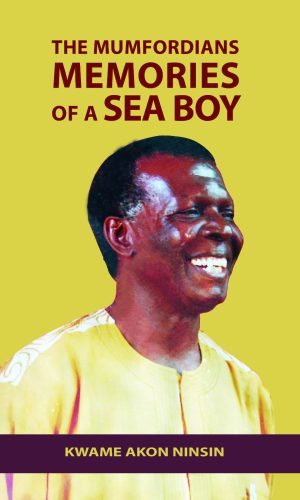
The Mumfordians: Memories of a Sea Boy
In one beautiful swoop, this book takes you to the nostalgic past and the aspirational future of an African nation still in the throes of defining self-determination. With the brilliance of powerful recalls, it dissects the socio-cultural as well as the political. It is one man’s journey from an idyllic African fishing village, through his self-improvement to become the executive secretary of a Pan-African body travelling several capitals of the world in the service of his employer.
It is also a book about people − their history, their dreams and the ills they seem unable to decidedly confront. But what makes The Mumfordians a keepsake is its richness in national promise and communal nostalgia.
₵210.00 -
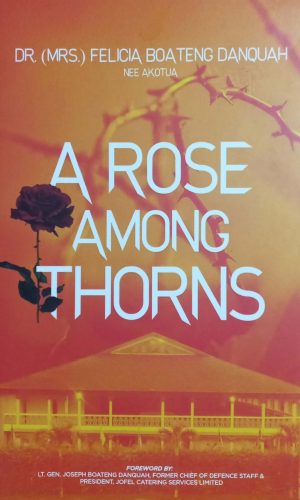
A Rose Among Thorns
Born on 17th September 1952 in Sakyikrom near Nsawam in Ghana’s Eastern Region, Dr. (Mrs.) Felicia Boateng Danquah (nee Akotua) is the third of five children born to her parents, Mr. Jonas Akotua and Mrs. Clara Akotua.
Due to her father’s regular transfers arising out of his employment with the Ghana Health Service, she was educated in different parts of the country, including Walewale and Bolgatanga, before entering the Komenda Teacher Training College (as it was then), where she trained as a teacher. She worked for some time with the Ghana Education Service as a teacher before going into business full-time.
A devoted Christian and Vice President of Jofel Catering Services in Kumasi, Dr. (Mrs) Danquah is married to Lt. Gen. J B Danquah, Ghana’s Chief of Defence Staff from 2005 to 2009 and President of Jofel. The couple have six children.
The year 2022 serves as a confluence of an important trilogy in Dr (Mrs.) Danquah’s life − her 70th birthday anniversary, the 50th anniversary of her marriage and the 40th anniversary of Jofel, one of the most iconic institutional names in Kumasi and an undoubted leader in the catering and hospitality business in the city and beyond.
In this fascinating, yet simple, easy-to-read publication to mark these important landmarks in her life, the author recalls her early childhood experiences and family, particularly her mother Clara, who she adores, and shares the story of Jofel and its evolution to what it is today.
She also shares her perspectives on the values she treasures that she believes have helped her enormously in her Christian faith, her marriage and family, and in building an award-winning business with the support of her family, among others.
A Rose Among Thorns speaks to the challenges of life that most of us can identify with and seek inspiration from in the knowledge that our lives can flourish like the rose even among the thorns of life with God as our helper and beacon.
₵150.00A Rose Among Thorns
₵150.00 -
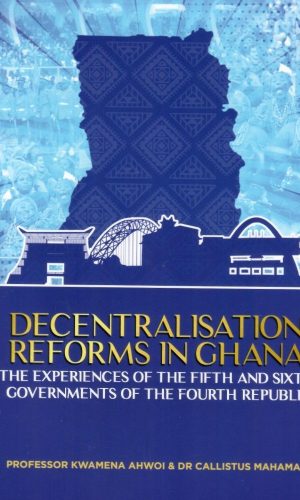
Decentralisation Reforms in Ghana: The Experiences of the Fifth and Sixth Governments of the Fourth Republic
What were the decentralisation reforms? What did they consist of? What were their origins? Who authorised them? What were their outcomes? What Impact have they had on the local governance and decentralisation landscape In Ghana?
The answer to the first question is that they were new initiatives and innovations designed to accelerate the pace of and improve upon decentralisation implementation in Ghana.
The answer to the second question is that they consisted of a National Decentralisation Policy Framework and a National Decentralisation Action Plan I (2010-2014) and II (2015-2019), an Inter-Ministerial Coordinating Committee on Decentralisation (IMCC), an expansion in the number of districts, a consolidated Local Governance Act, a re-branding of the Office of the Head of Local Government Service, the operationalisation of the Local Government Service and the introduction of a system of Inter-Service/Inter-Sectoral Collaboration and Cooperation. It also covered the enactment of National Development Planning (System) Regulations and a Land Use and Spatial Planning Act, the introduction of a Regional Integrated Budget System (RIBS) and blueprints for an Inter-Governmental Fiscal Framework (IGFF) and an Inter-Governmental Fiscal Transfer (IGFT) system.
The answer to the third question is that the reforms were traceable to the 2008 manifesto of the National Democratic Congress (NDC), the party which won the Presidential and Parliamentary elections of 2008 and 2012 and therefore formed the Fifth and Sixth Governments of the Fourth Republic.
The answer to the fourth question is that the reforms were authorised by Presidents John Evans Atta Mills and John Dramani Mahama who successively were Presidents of the Fifth and Sixth Governments of the Fourth Republic.
The answer to the fifth question about outcomes is the new structures, procedures and processes for decentralisation implementation, the improved quality of human resources in the local government sector, and the more efficient systems of checks and balances in the sector.
The answer to the sixth question lies in the District Assemblies (MMDAs), the better service delivery by the Metropolitan, Municipal and of service delivery, the renewed interest in local governance by the citizenry and the claro Si rate reforms such as the elections of Metropolitan, Municipal and District Chief Executives (MMDC Wand making the MMDAs partisan.
These and answers to other questions posed by the reforms are answered in this book by the two people who should know, namely, the authors Professor Kwamena Ahwoi and Dr Callistus Mahama.
Professor Kwamena Ahwoi is the longest-serving Minister of Local Government and Rural Development in Ghana (1988-2000). He was the Chairman of the High Level Strategic Task Force that produced the Decentralisation Policy Frameworks and Action Plans, He chaired the Legislative Review Task Force that resulted in the enactment of the Local Governance Act, 2016, Act 936 and was consultant to both the Ministry of Local Government and the IMCC during the period.
Dr. Callistus Mahama was a member of the High Level Strategic Task Force, a member of the Legislative Review Task Force, the Executive Coordinator of the IMCC and the Head of the Local Government Service during the period.
The two authors therefore write from a position of knowledge and experience and this is reflected in the contents of the book.
₵95.00