-
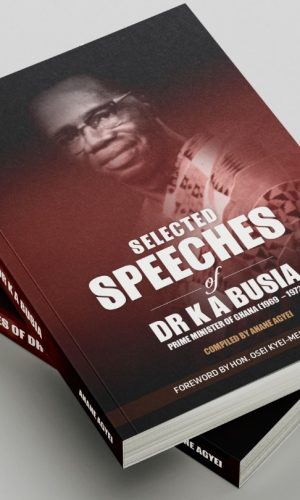
Selected Speeches of Dr. K. A. Busia: Prime Minister of Ghana (1969-1972)
This is a compendium of speeches by Dr. K.A. Busia, a world-renowned politician and scholar, Africa’s first Leader of Parliamentary Opposition in an independent country south of the Sahara and Prime Minister of Ghana (1969-1972).
His commitment to multiparty democracy is demonstrated throughout the pages. For example, he objected strongly to the decision to turn Ghana into a one-party state in the First Republic, saying, “One-party rule for Ghana, in the light of our traditions, is a step backward from the accumulated wisdom we inherited from our ancestors.”
Today, one-party rule is a taboo to the Ghanaian constitution and Busia’s preferred economic and governance modules have become the bedrock for governance, demonstrating the continuing relevance of his ideas to contemporary politics.
₵50.00 -
Axioms of Dr. K. A. Busia: A Compilation of Philosophies, Ideas and Policies of a Statesman
This book reflects the thoughts of K. A. Busia, Ghana’s first university professor and prime minister of the 2nd Republic. It consists of extracts from his writings as a scholar, politician and statesman.
The book deals with issues regarding democracy, the rule of law, good governance, our common humanity, knowledge and
education, among others.It is a requisite companion for academics, politicians, the clergy, traditional rulers, historians, researchers, students and all those who subscribe to the tenets of democracy.
₵50.00 -
Justice Denied
This book was written soon after the suspects of the murder of the Ya-Na were arrested.
The author followed the unveiling accounts of the murder of the Ya-Na,the commitment and indictment proceedings at the Magistrate Court.He also followed the trial of the accused persons at the High Court.
The search for Justice for the Ya-Na became a judicial drama and a political football instead.Some key players in the search exhibited palpable incompetence and nonchalance while others showed unpardonable bias in the performance of their judicial and legal duties. In resistance to the search for justice all kinds of novel and spurious legal arguments were raised ,including the issue of when does a confession have effect in law even if it is freely given?
“Another spurious legal issue raised was the fact of the Ya-Na’s death .In recognition of his service to his nation and traumatic murder, the Republic of Ghana gave Naa Yakubu II a state burial on 10th April,2016. Yet in order to deny him justice and to make the law seem to be an ass,the fact of his death and identity of his body became issues in the trail of persons accused of murdering him.This kept the ordinary Ghanaian wondering where the implementers of the law were taking the country.In the end the Ya-Na was denied Justice”.
₵50.00Justice Denied
₵50.00 -
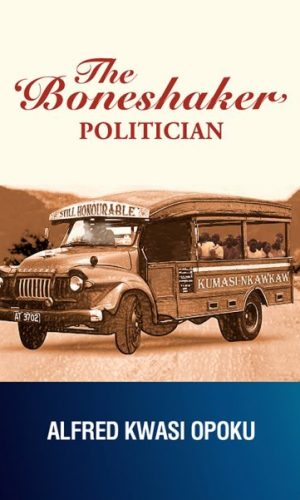
The Boneshaker Politician
The Boneshaker Politician is an autobiography of A.K. Opoku. He narrates how he gave his life to Christ in a dramatic way while travelling in a boneshaker, a wooden truck. He recounts how the Lord used him by way of evangelism and church building and his involvement in an uncompromising undercover politics in the church. Meanwhile he had nursed a childhood ambition of being an active politician.
With all his “boneshaker” experience, he entered into politics and discovers that it was a different world altogether and bemoans the high moral and the financial entry requirements required of a Christian to engage in active politics. He raises question as to whether exhortations to get Christians involved in active politics is enough. He concludes with his family life and marvels at the art of God where four children of the same parentage and breed have four different characters and ambitions.
₵50.00The Boneshaker Politician
₵50.00 -
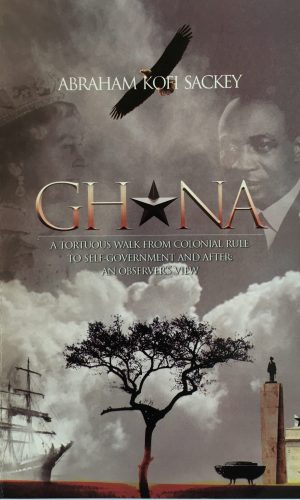
Ghana: A Tortuous Walk from Colonial Rule to Self Government and After – An Observer’s View
In Ghana: A Tortuous Walk from Colonial Rule to Self-Government and After – An Observer’s View, the author takes the stand of an engaged citizen who watched the closing transformation of tribal states into colonial Gold Coast, and its metamorphosis into independent Republic of Ghana. Through his attachment to his nation, and from the perspective of an observer of the political process, he emotively describes the procession of events, the people and passions that brought the momentous occasion of independence, the dashing of hopes as political stability was continually disrupted through coup d’etats, and the character and contributions of the various regimes that took over the leadership of Ghana. He takes us on a walk through the 1st, 2nd, 3rd and now the 4th Republic, and describes the promises that the present dispensation of democracy makes to the Ghanaian. His presentation of how present-day Ghana has evolved explains the mixed emotions of anxiety and hope that shape the national outlook and the consistent angst exuding through fractious political groupings.
The book is a must read for every person who wishes to know and understand the various events that have shaped the Ghana of the early 21st century.
₵50.00 -
The Baobab: A Journal of the Council on Foreign Relations-Ghana (Vol 1, No 1 – January 2020)
IN THIS ISSUE
From the President of the Council
Editorial
The Need for a Diplomatic Think Tank
Ambassador James Victor Gbeho
Council on Foreign Relations Overdue
HE Nana Addo Dankwa Akufo-Addo, President of Ghana
Kofi Annan Biography
Memories of a Good Man from Africa
Amb Patrick Hayford
Getting to Know Kofi Annan
Excerpts from A Conversation With Mary Chinery-Hesse
(Interview by Lady Ann-Essumạn)
Kofi Annan, Africa and the Responsibility to Protect
Ramesh Thakur
Ghana in United Nations Peace Operations, A Tool of its Foreign Policy
Colonel Festus Boahen Aboagye (Retired)
Peacekeeping Experiences, Creating National Bonds
Major General HK Anyidoho (Retired)
Rethinking a New Global Order
V Antwi-Danso, PhD
Partnerships for Peace in West Africa and the Sahel: Challenges and Opportunities
Dr Mohamed Ibn Chambas
About the Contributors
Editorial Policy and Guildlines
History of CFR-Ghana
₵50.00 -
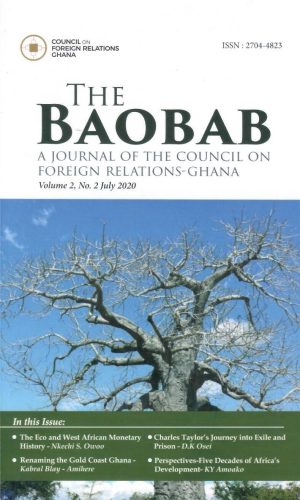
The Baobab: A Journal of the Council on Foreign Relations-Ghana (Vol 2, No 2 – July 2020)
IN THIS ISSUE
From the Managing Editor
Editorial
Members in the News
Covid-19: 10 Policy Priorities for Africa’s Recovery, Growth and Transformation
The Eco and West African Monetary History
Nkechi S. Owoo
Special Review Essays and Features on: Ghana, Liberia and Africa in Historical Transitions
Renaming the Gold Coast Ghana
Kabral Blay-Amihere
Still Contested After All these Years
David Owusu-Ansah
Ghana: The Secession Movement and the Trans-Volta Togoland
Boni Yao Gebe
Charles Taylor’s Journey into Exile and Prison
DK Osei
Perspectives-Five Decades of Africa’s Development
KY Amoako
About the Contributors
Editorial Policy and Guidelines
History of the CFR-Ghana
₵50.00 -
Celebrated: Nigerian Women in Development
Celebrated profiles 29 contemporary Nigerian women who, through their own initiatives, are playing laudable roles in our society. They include lawyer and civil liberties activist Ayo Obe, fashion designer Deola Sagoe, and businesswoman Nike Ogunlesi. These women speak in Celebrated about their experiences, challenges and successes.
The problems relating to the social worth of a woman, her ability to contribute to social development, the political, economic and social roles she is allowed to play, her pains and travails are issues that haunt all societies. These problems usually arise from the way society sees the woman and the way the woman sees herself. Perhaps because of these problems, despite the past achievements of Nigerian women, the number of prominent contemporary Nigerian women remains negligible compared to that of men.
Ayona Aguele-Trimnell profiles here a few contemporary Nigerian women who, through their own initiatives, are playing laudable roles in society and yet remain largely uncelebrated. Women like Doctors Okonjo-Iweala, Obiageli Ezekwesili and Professor Dora Akunyili to name a few, who have performed as well as any, and better than most of their male contemporaries and predecessors. This is the sense in which this book become important.
₵50.00 -
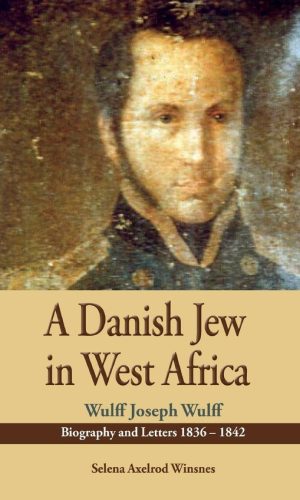
A Danish Jew in West Africa: Wulff Joseph Wulff Biography And Letters (1836-1842)
Wulff’s life history is of considerable interest in itself. In her biographical essay (Part I) Selena Axelrod Winsnes portrays him as a ‘marginal man’: being a Jew in Denmark at the beginning of the 19th century was to some extent an uphill struggle for those who sought public recognition, and Wulff did not escape discrimination in his administrative career at Christiansborg either, although special circumstances allowed him to hold important positions, and yet, only for the short term.
Paradoxically, on his arrival to the Gold Coast Wulff — as a Jew — was placed in a middle position in the racial hierarchy dominating the mind-set of his superiors in Copenhagen — between Africans and Europeans. In many respects he shared the fate of Euro-Africans, straddling two worlds and being ‘sealed off’ from the top echelons of the European establishments on the Coast.
This book comprises two parts. The first is a biographical presentation of Wulff Joseph Wulff , a Danish Jew. It is an essay concerning the last six years of his life, spent on the Gold Coast of West Africa, based on letters he wrote to his family in Denmark. Those letters were published in 1917 as Da Guinea var Dansk [When Guinea was Danish], by Carl Behrens, a member of his family in Denmark. The second part of the book is an edited translation of the letters from Danish into English.
₵55.00 -
Two Views from Christiansborg Castle Vol II: A Description of the Guinea Coast and its Inhabitants
Selena Axelrod Winsnes has been engaged, since 1982, in the translation into English, and editing of Danish language sources to West African history, sources published from 1697 to 1822, the period during which Denmark-Norway was an actor in the Transatlantic Slave Trade. It comprises five major books written for the Scandinavian public. They describe all aspects of life on the Gold Coast [Ghana], the Middle Passage and the Danish Caribbean islands [US Virgin Islands], as seen by five different men. Each had his own agenda and mind-set, and the books, both singly and combined, hold a wealth of information – of interest both to scholars and lay readers. They provide important insights into the cultural baggage the enslaved Africans carried with them to the America’s.
One of the books, L.F. Rømer’s A Reliable Account of the Coast of Guinea was runner-up for the prestigious International Texts Prize awarded by the U.S. African Studies Association.
₵55.00 -
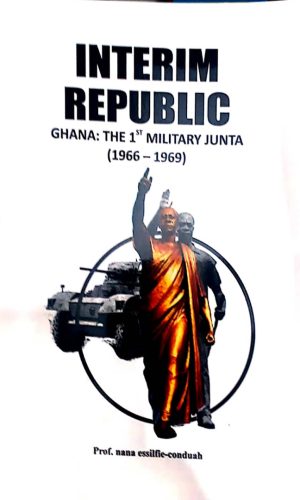
Interim Republic: Ghana – The 1st Military Junta (1966 – 1969)
When the long years of plotting by foreign powers with Ghanaian collaborators to upset governance in Ghana finally succeeded, many justification books and laudatory pamphlets and newspaper articles were published at home and abroad. Some bore pseudonames, others came forceful. The event which occasioned the potpourri was the 1st military coup d’etat in Ghana staged by a military and police combine.
The Military/Police combination which overtook the government of Ghana, the 1st Republic Convention People’s Party (CPP)-led government in that putsch, installed an administration which came to be known as the National Liberation Council (NLC).
This book sheds much-needed light on their lives and times.
₵55.00 -
Two Views from Christiansborg Castle Vol I: A Brief and Truthful Description of a Journey to and from Guinea
Selena Axelrod Winsnes has been engaged, since 1982, in the translation into English, and editing of Danish language sources to West African history, sources published from 1697 to 1822, the period during which Denmark-Norway was an actor in the Transatlantic Slave Trade. It comprises five major books written for the Scandinavian public. They describe all aspects of life on the Gold Coast [Ghana], the Middle Passage and the Danish Caribbean islands [US Virgin Islands], as seen by five different men. Each had his own agenda and mind-set, and the books, both singly and combined, hold a wealth of information – of interest both to scholars and lay readers. They provide important insights into the cultural baggage the enslaved Africans carried with them to the America’s.
One of the books, L.F. Rømer’s A Reliable Account of the Coast of Guinea was runner-up for the prestigious International Texts Prize awarded by the U.S. African Studies Association.
₵55.00